
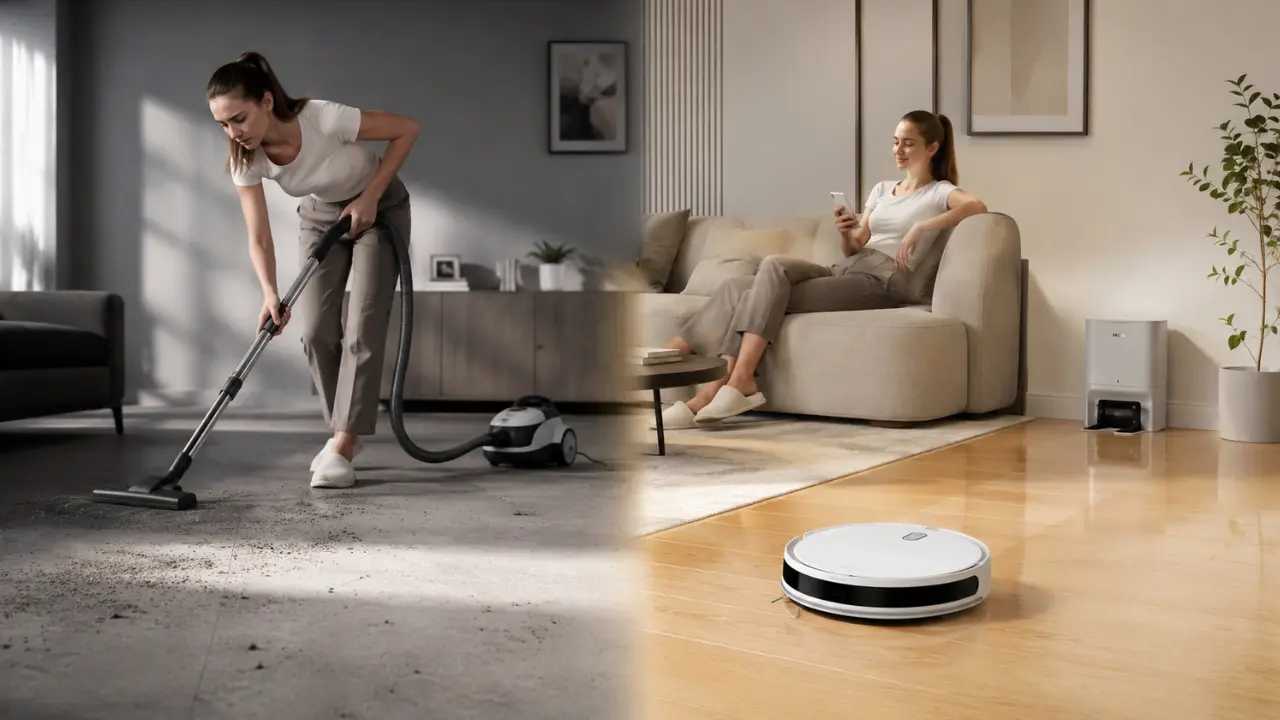

Sure, if you only want to deep clean occasionally, a regular vacuum cleaner still works great. However, if you want a consistently clean home with minimal effort, the robot vacuum cleaner is usually the more intelligent option these days, especially for busy Indian households.
It’s not about which robot vacuum cleans better.
It’s about.
Do you want to spend time cleaning your floors, or would you rather cleaning happen as you go about doing life’s other tasks?
That distinction changes the entire buying decision.
Why does this comparison matter more than ever?
Walk into any Indian home on a weekday evening.
Someone is finishing work calls.
Children are moving between tuition and playtime.
Dinner preparation has already started.
The floor somehow has dust again.
Not because anyone cleaned poorly.
Because homes are living systems.
Dust enters through windows. Hair falls. Crumbs appear. Pet fur spreads. Foot traffic never stops.
This is why vacuum cleaner buying decisions are changing.
People are no longer asking:
“Which vacuum is more powerful?”
They are asking:
“Which cleaning system fits the way we live?”
And that is a much better question.
Understanding the Difference Between Robot and Traditional Vacuums
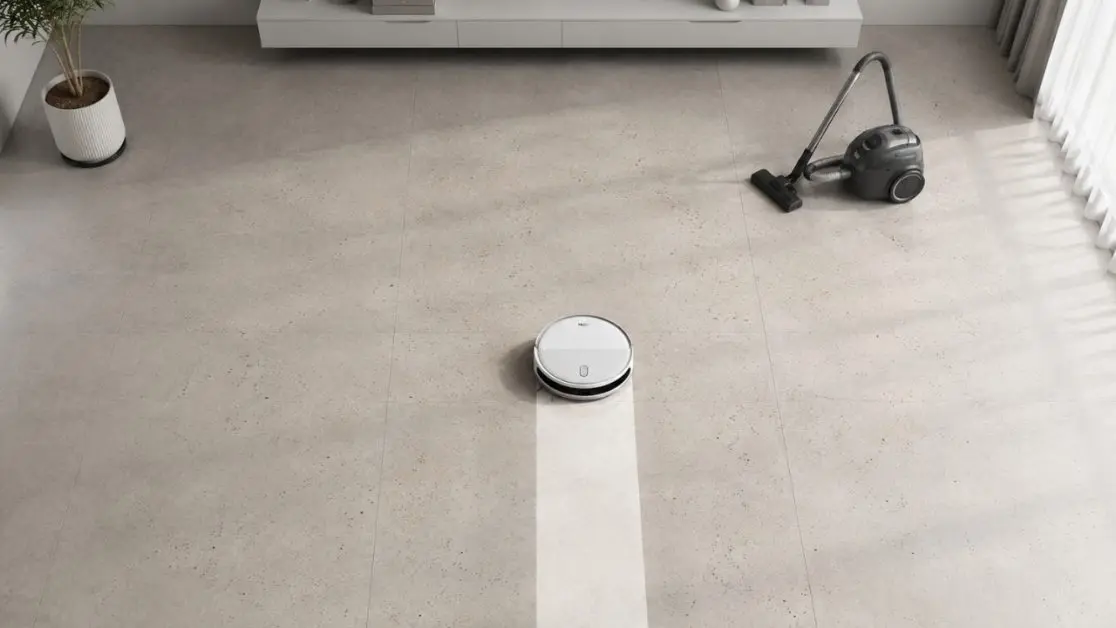
At first glance, both products solve the same problem.
They remove dust.
But the way they solve it is completely different.
Traditional Vacuum Cleaner
A traditional vacuum depends on human effort.
You take it out.
You move it room to room.
You decide where to clean.
You decide when to stop.
The machine provides suction.
You provide the system.
Robot Vacuum Cleaner
A robot vacuum reverses that relationship.
You create the schedule.
The machine does the movement.
The machine plans the route.
The machine returns to charge.
The machine becomes the system.
That shift sounds small.
It is not.
Because convenience compounds.
Just like savings.
Just like habits.
Robot Vacuum Cleaner vs Traditional Vacuum: The Real Comparison
Cleaning Effort
Traditional vacuum cleaners require active involvement.
Every cleaning session demands your time and attention.
Robot vacuum cleaners work automatically.
Many modern models can clean while you’re working, shopping, sleeping, or watching television.
The hidden benefit of automation is consistency.
Most people vacuum less often than they think.
Robot vacuums clean more frequently because effort is removed from the equation.
Daily Maintenance
Traditional vacuum:
- Requires manual operation
- Needs storage and setup every time
- Usually used once or twice a week
Robot vacuum:
- Scheduled cleaning
- Automatic charging
- Minimal day-to-day involvement
A clean floor is often the result of a repeatable system, not a heroic cleaning session.
Which Vacuum Cleaner Handles Indian Homes Better?
Indian homes present unique cleaning challenges.
Common Household Conditions
- Dust from open windows
- Hair fall
- Pet fur
- Food crumbs
- Daily foot traffic
- Mixed flooring surfaces
A vacuum cleaner that works perfectly in one environment may struggle in another.
Traditional Vacuum Strengths
Traditional vacuums are useful for:
- Deep-cleaning mattresses
- Sofa cleaning
- Curtains
- Car interiors
- Stairs
They offer direct control.
You target exactly where you want to clean.
Robot Vacuum Strengths
Robot vacuums excel at:
- Daily floor maintenance
- Large living rooms
- Bedrooms
- Hallways
- Under-bed cleaning
- Under-sofa cleaning
These are spaces people often ignore because reaching them takes effort.
The places we avoid cleaning usually become the places that need cleaning most.
Why Smart Navigation Changes Everything
Many people imagine robot vacuums randomly bumping into furniture.
That was yesterday’s technology.
Modern robot vacuum cleaners use intelligent navigation systems.
For example, Haier’s CIVIC X11 and CIVIC X11 PRO robot vacuum cleaners use laser navigation technology for precise route planning and obstacle detection.
They can store up to five floor maps, making them suitable for multi-room homes and different layouts.
What This Means in Real Life
The robot knows:
- Where it has cleaned
- Where it needs to clean
- Where obstacles exist
- Which rooms belong to which map
Instead of moving randomly, it moves with purpose.
Smart homes are not about more technology.
They are about less friction.
The Time Equation Nobody Talks About
Let’s think differently.
Suppose a traditional vacuum session takes 25 minutes.
Three times a week.
That is 75 minutes weekly.
Over a year?
More than 65 hours.
Nearly three full days.
The question is not whether vacuuming takes effort.
The question is whether that effort is where you want your time invested.
One Option: Maximum Manual Control
Choose a traditional vacuum.
Benefits:
- Direct cleaning control
- Good for targeted cleaning
- Useful for upholstery
Cost:
- Requires your time
Second Option: Automated Daily Cleaning
Choose a robot vacuum.
Benefits:
- Consistent floor cleanliness
- Scheduled cleaning
- Minimal intervention
Cost:
- Higher initial investment
Third Option: Use Both
Many modern households do exactly this.
Robot vacuum for everyday maintenance.
Traditional vacuum for occasional deep cleaning.
This often delivers the best of both worlds.
What About Homes with Pets?
Pet owners often discover something interesting.
The challenge is not pet hair.
The challenge is how quickly pet hair returns.
A floor cleaned on Sunday may need attention again by Tuesday.
That is where automation becomes valuable.
Haier’s CIVIC X11 PRO is designed with pet-friendly cleaning in mind and helps manage pet hair, dander, and daily messes while maintaining regular floor hygiene.
Daily cleaning often beats occasional deep cleaning.
Consistency wins.
Smart Features Are Reshaping Home Cleaning
The biggest shift is not suction power.
It is intelligence.
Modern robot vacuum cleaners increasingly include:
- Mobile app control
- Voice assistant integration
- Scheduled cleaning
- Multi-map memory
- Auto return to charging docks
Haier CIVIC X11 and CIVIC X11 PRO support app-based control along with compatibility with Alexa and Google Assistant. Both models also feature powerful 5000Pa suction, wet and dry cleaning capabilities, and up to 120 minutes of runtime.
The CIVIC X11 PRO further includes an auto-empty dust station that automatically transfers collected dust into a larger storage unit, reducing manual emptying frequency.
That is not just convenience.
That is a redesign of the cleaning experience itself.
So, Which One Should You Buy?
The answer depends less on the machine and more on your lifestyle.
A Traditional Vacuum Makes Sense If:
- You prefer hands-on cleaning
- You need upholstery and mattress cleaning regularly
- You clean less frequently but more intensively
- Budget is the primary consideration
A Robot Vacuum Cleaner Makes Sense If:
- You have a busy schedule
- You want daily floor maintenance
- You have pets or children
- You value automation
- You prefer smart home ecosystems
For Most Modern Indian Homes
The trend is becoming clear.
People are moving from cleaning events to cleaning systems.
From occasional effort to continuous maintenance.
From manual routines to intelligent automation.
That is why robot vacuum cleaners are becoming increasingly relevant in urban Indian households.
Not because they replace cleaning.
Because they make cleanliness happen more consistently.
Final Thought
Most appliance decisions are really time decisions in disguise.
A refrigerator protects freshness.
A washing machine protects effort.
A smart AC protects comfort.
And a robot vacuum cleaner protects something equally valuable.
Attention.
The cleanest homes are rarely cleaned by people who work harder.
They are maintained by systems that work smarter.
That is the hidden shift behind the rise of robot vacuum cleaners.
And once you see cleaning as a system rather than a task, the buying decision becomes much easier.
Frequently Asked Questions
What’s the main difference between a robot vacuum cleaner and a traditional vacuum cleaner?
A traditional vacuum requires manual operation; you guide it and decide when and where to clean. A robot vacuum automates the process by navigating your home, cleaning on a schedule, and returning to its charging dock automatically.
Which vacuum cleaner is better overall?
Neither is universally better. Traditional vacuums excel at deep, targeted cleaning, while robot vacuums are designed for consistent daily floor maintenance with minimal effort.
Should I buy a robot vacuum or a regular vacuum cleaner?
Your decision depends on your lifestyle. If you value automation and daily cleanliness, a robot vacuum is a great choice. If you mainly perform occasional deep cleaning, a traditional vacuum may be sufficient.
Is a robot vacuum cleaner worth the extra cost?
For many households, yes. While the initial investment is higher, automated daily cleaning saves time and helps maintain cleaner floors with less manual effort.
Does a robot vacuum clean as well as a traditional vacuum?
For everyday floor cleaning, modern robot vacuums can deliver excellent results. Traditional vacuums generally offer greater flexibility and are better suited for deep cleaning upholstery, mattresses, stairs, and hard-to-reach areas.