
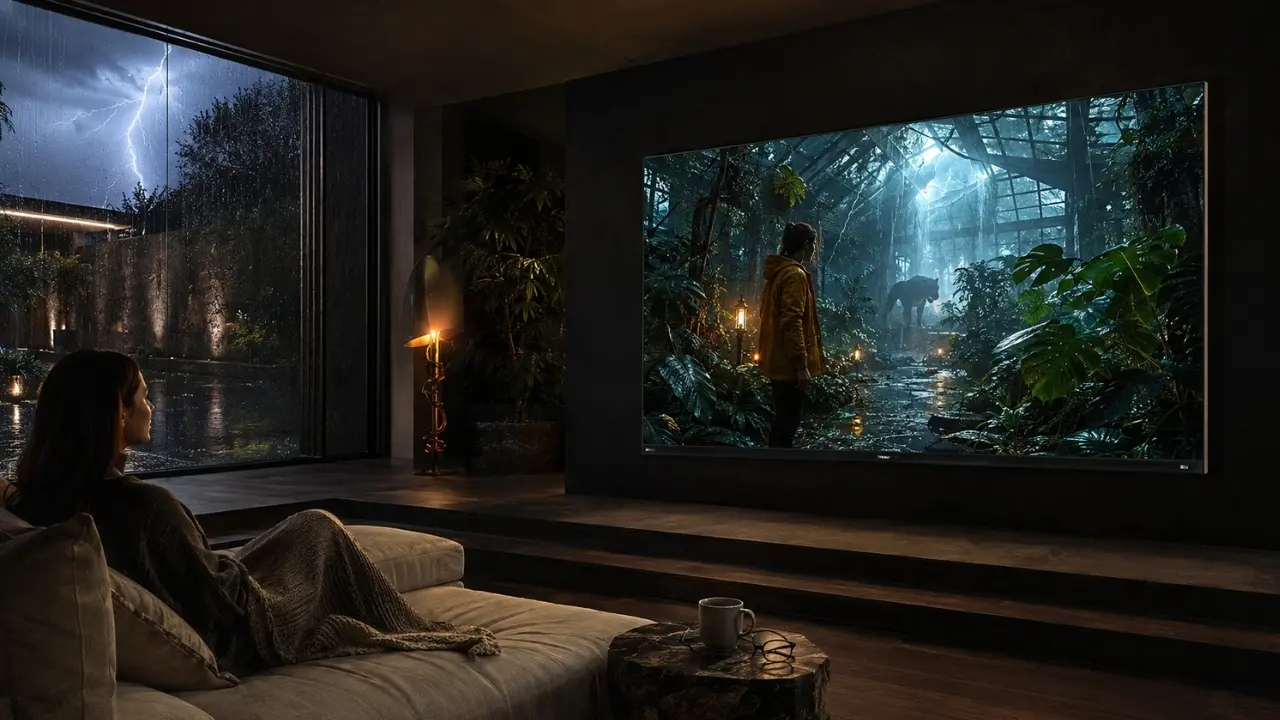

You switch on the television, open an OTT app and start a new series. The picture looks spectacular. Blacks feel deep, highlights sparkle, faces retain fine detail and even a dimly lit room looks convincingly cinematic.
Then you play something else on the same app, through the same internet connection, on the same television and suddenly the image seems flatter.
So, what changed?
Quite a lot, actually.
OTT picture quality is not decided by a single factor called “4K”. What finally appears on your television is the result of an entire chain: how the programme was filmed, how it was mastered, the resolution and dynamic range available, how heavily it was compressed for streaming, your network conditions and, finally, what your television can reproduce.
That is why understanding why some OTT content looks better than others is useful before assuming that every programme carrying a similar resolution badge should look identical.
Two Shows Can Both Be 4K and Still Look Completely Different
Resolution is usually the first specification people notice. It matters, certainly. But it tells only part of the story.
A 4K video contains more pixels than a lower-resolution source, but those pixels still need useful visual information. If the original production lacks fine detail or the stream has undergone stronger compression, simply having a high pixel count cannot magically restore what is missing.
Think of it another way. Two photographs may have identical dimensions, yet one can look crisp and carefully exposed while the other looks washed out. Television content works along similar lines.
What matters includes:
- Original camera and production quality
- Mastering and colour grading
- Streaming resolution
- Video bitrate and compression
- HDR format
- Frame rate and motion
- Internet stability
- The television’s display and picture-processing capabilities
And, occasionally, the visual difference is intentional. A director may choose softer photography, heavy film grain, restrained colours or extremely dark scenes. Better picture quality does not always mean brighter and sharper.
The Hidden Difference: Streaming Bitrate
This part rarely gets the same attention as resolution, although viewers notice its effects all the time.
OTT platforms need to deliver enormous amounts of video data over the internet. Sending completely uncompressed cinema-quality footage to every household simply isn’t practical. Streaming video is therefore compressed.
The amount of video information transmitted over a given period is broadly described through bitrate.
Higher-quality streams can preserve more visual information. More aggressive compression may sacrifice some of it to keep playback manageable.
You are most likely to notice compression during demanding scenes such as:
- rain or snowfall;
- smoke, fire and flying particles;
- fast camera movement;
- crowds and sporting action;
- detailed forests or cityscapes;
- very dark scenes with gradual shadow changes.
An uncomplicated close-up against a plain background is relatively easy to encode. A night-time action sequence full of movement, sparks, shadows and changing light? Much harder.
This explains a curious OTT experience: sometimes a quiet conversation looks wonderfully clean while the next action sequence suddenly appears less precise.
HDR Can Change the Experience More Than Extra Pixels

Here is another reason one programme may immediately look richer than another: High Dynamic Range, or HDR.
HDR content is designed to reproduce a broader range between bright highlights and dark portions of the picture when displayed on compatible equipment. Properly implemented, this can give scenes considerably more depth.
Consider an evening scene containing a dark street, illuminated shop signs, car headlights and reflections on wet roads. The challenge is not simply displaying those objects. The television has to distinguish bright highlights while retaining meaningful information within darker areas.
That is where display capability starts becoming important.
Dolby Vision and HDR10 on the Haier M80F Mini LED TV
The Haier M80F Mini LED Google TV series supports Dolby Vision and HDR10, giving viewers access to compatible HDR content in formats designed to preserve a broader visual range.
The series uses Mini LED display technology, which Haier describes as providing vibrant colours, deep blacks and an immersive viewing experience. Local dimming is also used, with the number of dimming zones varying by screen size.
For viewers who regularly watch visually ambitious OTT films, premium drama series, documentaries or nature programming, those capabilities can make the difference between merely seeing an image and appreciating the layers inside it.
What Actually Determines the Picture You See?
There is no single winner here. OTT quality is a chain, and the weakest part of that chain can become visible on screen.
| Part of the Viewing Chain | What It Can Influence |
| Original production | Detail, lighting, camera quality and visual style |
| Mastering | Colour, contrast, HDR presentation and overall tonal balance |
| OTT stream | Resolution, compression and available video information |
| Internet connection | Whether the service can maintain a higher-quality stream consistently |
| TV display | Contrast, brightness, colour reproduction and black levels |
| Picture processing | Motion handling and presentation of challenging scenes |
The last two deserve more attention than they often receive.
A premium source deserves a display capable of showing what is actually present in that source.
Mini LED Matters Most When the Scene Gets Difficult
Bright daytime footage tends to look respectable on many televisions.
Dark content exposes differences much faster.
Imagine a suspense thriller where someone walks through a barely illuminated corridor. The frame contains near-black walls, a small lamp, reflections from a window and a face partly hidden in shadow.
If dark portions of the frame become one grey mass, the scene loses depth. If bright areas overpower nearby dark areas, subtle detail can disappear.
Mini LED technology addresses display backlighting with much smaller LEDs and localised control, helping the television manage bright and dark portions of an image more precisely.
Across the Haier M80F range, local dimming varies according to screen size:
- 140 cm (55) H55M80FUX: 144 local dimming zones
- 165 cm (65) H65M80FUX: 180 local dimming zones
- 189 cm (75) H75M80FUX: 264 local dimming zones
For OTT viewers, that becomes especially relevant with films and programmes containing substantial contrast space scenes, night photography, dramatic interiors, stage performances and colourful animation among them.
Motion Is Another Reason Content Can Look “Better”
Picture quality isn’t frozen in place. Television is motion.
A slow drama and a football match challenge a display differently. So do chase sequences, wildlife footage and rapid camera pans.
When objects move quickly across the frame, viewers may notice blur or a loss of clarity. Source frame rate is one part of that equation; television motion handling is another.
The Haier M80F features MEMC, which is designed to help reduce motion blur by introducing additional frames between original frames. The series also offers DLG 120 Hz for smoother motion in fast-paced viewing scenarios.
That means the difference you perceive while jumping between OTT programmes may sometimes be less about colour or resolution and more about movement itself.
And Then There Is Sound Which Changes How Good the Picture Feels
Sounds odd, but try watching the same dramatic sequence once with powerful audio and once with thin, unclear sound.
It doesn’t feel like the same scene.
Immersion is audiovisual. Better dialogue clarity, deeper bass and a more spacious soundtrack can make even an already impressive picture feel far more cinematic.
The Haier M80F Mini LED series pairs its visual capabilities with Sound by KEF, along with a 50W 2.1-channel audio system and Dolby Atmos.
The 2.1-channel configuration adds dedicated low-frequency support for fuller bass, while Dolby Atmos is designed to create a more immersive sense of sound around the viewer.
For OTT content mixed with detailed sound design films, concert programming, documentaries and premium drama in particular audio stops being something sitting underneath the picture. It becomes part of the experience.
Your Internet Connection Can Quietly Lower Quality
Sometimes, neither the content nor the television is the problem.
The network is.
Most streaming services adapt playback quality according to available connection conditions. When bandwidth becomes constrained or unstable, the stream may reduce quality so the programme continues instead of repeatedly buffering.
That can lead to:
- softer images;
- temporarily lower resolution;
- more visible compression;
- reduced fine detail.
If one programme looks unexpectedly poor, especially immediately after playback begins, giving the stream some time or checking network stability can be worthwhile.
A premium television can reproduce the information it receives exceptionally well. It cannot recreate source information that never reached it.
Google TV Makes Finding the Content Part Easier Too
Picture quality receives most of the attention, but modern OTT viewing has another problem: finding something worth watching among a very large number of apps.
The Haier M80F runs Google TV, providing curated content recommendations and personalized suggestions. It also supports Google Assistant-enabled voice control, Chromecast built-in and access to the Google Play Store.
In practical household use, this matters. Indian families often move between films, sports, regional programming, children’s entertainment, music and international series rather than remaining inside one content category.
The television therefore needs to do more than display OTT content beautifully. It should make navigating that expanding library straightforward as well.
Before Blaming Your TV, Check These Five Things
If a particular OTT programme does not look as impressive as expected, a quick diagnosis usually helps.
- Check the source quality. Older programmes and archive content may simply contain less visual information.
- See whether HDR is available. SDR and HDR versions of similar-looking content can produce noticeably different experiences.
- Check the network. A fluctuating connection can cause adaptive streaming quality to drop.
- Consider the filmmaking style. Grain, muted colour or darkness may be deliberate creative choices.
- Look at the display itself. Contrast control, local dimming, HDR capability and motion processing become increasingly valuable with demanding content.
That final point becomes especially important as streaming libraries contain more visually sophisticated productions.
Better OTT Viewing Starts With Understanding the Entire Chain
The interesting thing about modern streaming is that “4K” no longer tells you everything you need to know.
One programme may arrive with excellent source photography, carefully mastered HDR, generous streaming data and complex surround sound. Another may be older, more compressed or intentionally restrained. Naturally, they will not look alike.
What you can control is the final part of that journey.
With Mini LED technology, Dolby Vision, HDR10, local dimming, MEMC, DLG 120 Hz, Sound by KEF, Dolby Atmos and Google TV, the Haier M80F Mini LED Google TV is built around the different elements that shape contemporary OTT entertainment.
Available in 140 cm (55), 165 cm (65) and 189 cm (75) screen sizes, the M80F series gives Indian households options for different rooms while retaining the core experience across the range.
Because the better the source becomes, the more capable the television needs to be.
And when a beautifully mastered OTT film finally comes along, you would rather see what the creators actually put there than wonder where half the detail went.
Frequently Asked Questions
1. Why does some OTT content look better even when both programmes are in 4K?
4K only describes resolution; it does not guarantee identical picture quality. Original production quality, mastering, HDR format, bitrate, compression and the television’s display capabilities can all influence the final image. This is why two 4K programmes can look noticeably different on the same TV.
2. Does internet speed affect OTT picture quality?
Yes. OTT platforms can adapt streaming quality according to available network conditions. If the connection becomes slow or unstable, playback quality may temporarily reduce to prevent buffering. A stable connection helps the service maintain the appropriate stream quality more consistently.
3. What difference does HDR make while watching OTT content?
HDR can provide a wider visual range between bright highlights and darker portions of an image on compatible content and displays. This becomes particularly noticeable in scenes containing strong contrasts, such as city lights at night, sunsets, reflections, fire or dim interiors.
4. Is Mini LED useful for watching movies and OTT series?
Mini LED technology can improve control over different bright and dark areas of the screen. The Haier M80F Mini LED Google TV series, for example, combines Mini LED technology with local dimming, Dolby Vision and HDR10, making it suited to visually detailed OTT films, series and other compatible HDR content.
5. Why do fast-action scenes sometimes look less clear than slower scenes?
Fast movement is more challenging to display than relatively static footage. Source frame rate, streaming compression and the television’s motion handling can all influence clarity. The Haier M80F includes MEMC for smoother motion handling and DLG 120 Hz for fast-paced viewing scenarios.
6. Which Haier M80F screen sizes are available?
The Haier M80F Mini LED Google TV range is available in 140 cm (55), 165 cm (65) and 189 cm (75) variants. The series includes Mini LED technology, Dolby Vision, HDR10, Google TV, Sound by KEF, Dolby Atmos and a 50W 2.1-channel audio system.