
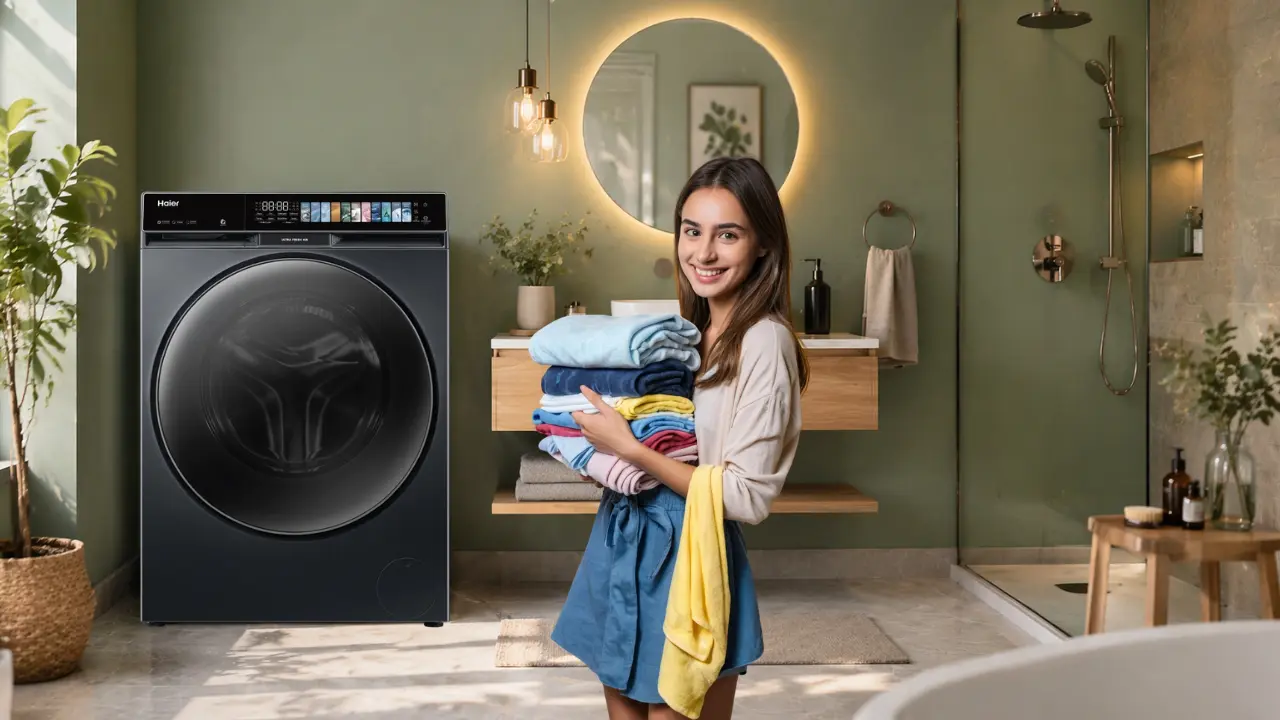

Smart laundry trends in Indian homes are shifting from manual effort to intelligent systems that save time, reduce effort, and improve fabric care.
From AI-powered wash cycles to app-controlled machines and energy-efficient designs, laundry is becoming faster, quieter, and far more intuitive for modern households.
Why does laundry suddenly feel like a system problem, not a chore?
It’s 9:30 PM.
Dinner is done. The sink is full. Tomorrow’s clothes are still in a pile.
And the washing machine?
Waiting.
This is where smart laundry trends in Indian homes begin. Not with technology. With time pressure.
Because laundry today is not just about cleaning clothes. It is about managing:
- Work schedules
- School uniforms
- Gym wear
- Festive outfits
- Last-minute plans
Laundry becomes a system. And systems demand efficiency.
The shift is simple: from effort-driven washing to decision-driven washing.
The rise of smart laundry trends in Indian homes
What exactly is changing inside Indian homes?
Smart laundry trends in Indian homes are not about adding more features.
They are about removing decisions.
Here’s what that looks like:
| Traditional Laundry | Smart Laundry Trend |
| Manual cycle selection | AI-based auto settings |
| Fixed wash patterns | Adaptive wash cycles |
| Noise and vibration | Silent night washing |
| Guesswork in detergent and water | Optimised resource usage |
| Physical control only | App and remote control |
According to industry reports, over 35% of urban Indian households now prefer appliances with automation features. The reason is not luxury.
It is predictability.
Trend 1: AI is becoming the decision-maker
What happens when washing machines start thinking?
You press one button.
That’s it.
Machines now detect fabric type, load size, and dirt level automatically, and adjust settings in real time.
This is not convenient. This is a delegation.
Because the hardest part of laundry is not washing.
It is deciding how to wash.
One insight stands out:
The more decisions a machine removes, the more valuable it becomes.
How AI changes everyday laundry decisions
- Cotton vs denim? No need to choose
- Light load vs heavy load? Automatically detected
- Water level? Adjusted dynamically
- Time and energy usage? Optimised per cycle
This is visible in modern machines where One Touch AI Wash simplifies the entire process into a single action.
The result:
Less thinking. Better outcomes.
Trend 2: Washing machines are becoming silent partners
Why does noise suddenly matter so much?
Because homes are changing.
Work-from-home calls. Late-night routines. Small apartments.
Noise is no longer acceptable.
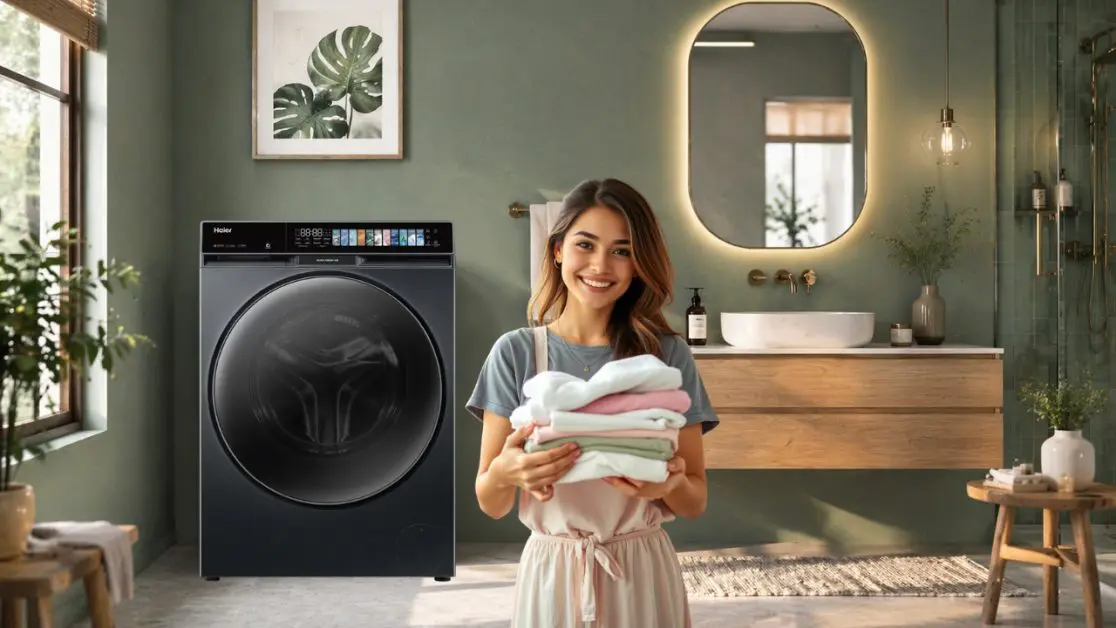
Smart laundry trends in Indian homes now include features like night wash modes that allow silent operation even at odd hours.
This is not about technology.
It is about respecting shared spaces.
The hidden system behind silent washing
- Direct motion motors reduce vibration and noise
- Fewer moving parts increase durability
- Energy efficiency improves alongside silence
Machines are no longer just appliances.
They are background systems.
And the best systems are invisible.
Trend 3: Hygiene is no longer optional
What changed after 2020?
People stopped asking, “Are clothes clean?”
They started asking, “Are clothes hygienically clean?”
Smart laundry trends in Indian homes now focus heavily on:
- Allergen removal
- Steam cleaning
- Anti-bacterial wash cycles
- Residue-free rinsing
Features like dual spray systems ensure detergent residue and allergens are removed effectively.
Because cleanliness today includes what you cannot see.
The cost-benefit shift of hygienic washing
Cost:
- Slightly longer cycles
- Slightly higher energy use
Benefit:
- Healthier fabrics
- Reduced skin irritation
- Better long-term garment care
The trade-off is clear. Health wins.
Trend 4: Larger capacity, fewer cycles

Why are Indian households choosing bigger machines?
Because laundry is batching.
Think about a Sunday morning.
Bedsheets. Towels. Daily wear. Kids’ clothes.
Everything gets washed together.
Machines with higher capacity like 10 kg and 12 kg options are becoming more common in Indian homes.
This is not about size.
It is about frequency reduction.
The real advantage of larger capacity
- Fewer wash cycles per week
- Lower overall electricity consumption
- Time saved on repetitive loads
- Better handling of bulky items
A bigger drum does not just wash more. It reduces how often you need to wash.
Trend 5: Energy and water efficiency are now personal decisions
When did efficiency stop being technical?
The moment electricity bills started rising.
Smart laundry trends in Indian homes now revolve around:
- Automatic water level adjustment
- Eco wash modes
- Load-based energy consumption
Machines now optimise water and energy based on actual load instead of fixed cycles.
This turns efficiency into a daily habit.
Understanding the efficiency equation
- Less water used per load
- Reduced detergent wastage
- Lower electricity consumption
- Longer machine life
Efficiency is no longer a feature. It is a system behaviour.
Trend 6: Laundry is becoming remote-controlled
Why control a washing machine from your phone?
Because time is fragmented.
You leave for work. You forget to start the wash.
Now you can start, pause, and monitor cycles through your phone.
Smart laundry trends in Indian homes now include Wi-Fi-enabled machines that integrate with mobile apps.
This is not about control.
It is about continuity.
What remote control actually solves
- Start laundry while commuting
- Check remaining time during meetings
- Get notifications when cycles end
- Avoid clothes sitting damp for hours
Laundry fits into your schedule, not the other way around.
Trend 7: Interfaces are becoming intuitive
Why does the display matter so much now?
Because usability defines adoption.
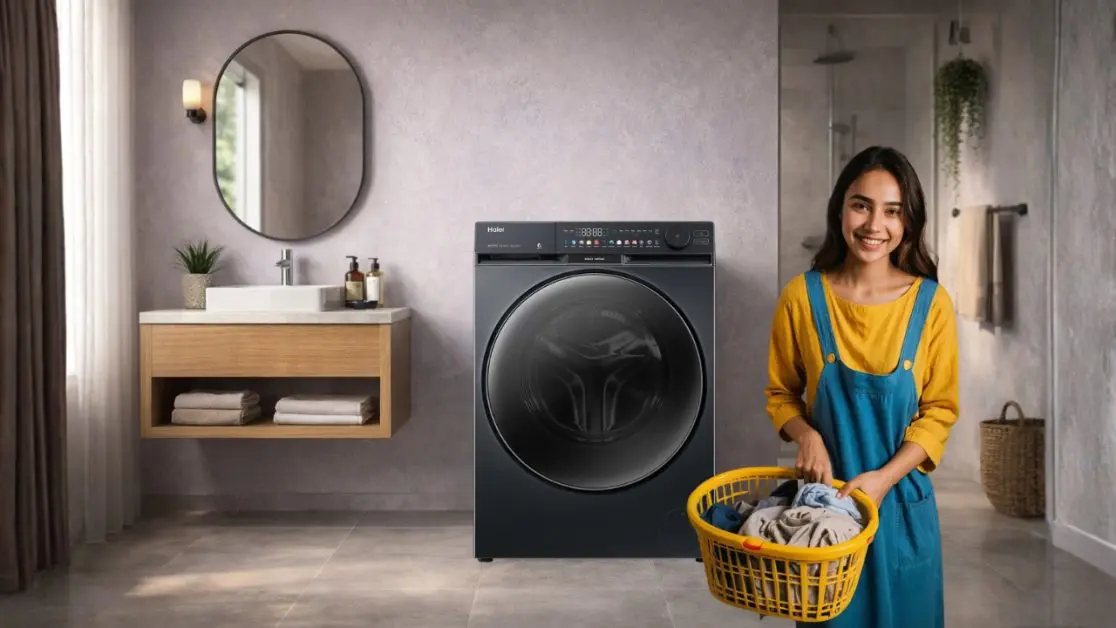
Modern machines now feature intuitive panels with dedicated programs for different fabrics.
This removes confusion.
The evolution of machine interfaces
- From buttons to touch panels
- From text labels to visual icons
- From generic programs to fabric-specific modes
When interfaces become simple, usage becomes consistent.
So what does all this mean for Indian homes?
Smart laundry is not about technology. It is about control.
Control over time.
Control over effort.
Control over outcomes.
Let’s break it down into choices.
Three ways Indian households approach laundry today
One option is manual control
You choose settings, monitor cycles, and adjust as needed.
It gives control but demands time.
The second option is semi-automation
Preset programs help, but decisions still exist.
It reduces effort but not entirely.
The third option is full smart automation
AI handles decisions, apps handle control, systems optimize performance.
It saves time, reduces errors, and improves outcomes.
The trade-offs are clear
| Approach | Benefit | Cost |
| Manual | Full control | Time and effort |
| Semi-automatic | Balanced approach | Partial dependency |
| Smart automation | Maximum efficiency | Initial investment |
The direction is obvious. Homes are moving toward systems that think.
The deeper shift most people miss
Laundry is becoming like electricity.
Always there. Rarely noticed. Fully reliable.
That is the goal.
Smart laundry trends in Indian homes are not about making washing exciting.
They are about making it irrelevant.
The insight worth remembering
The best appliance is the one you stop thinking about.
When machines start handling decisions, you start reclaiming time.
And in modern Indian homes, time is the most valuable resource.
What this means for how we choose next
The next washing machine decision is no longer about RPM or programs.
It is about systems.
- Does it reduce decisions?
- Does it adapt to your lifestyle?
- Does it save time consistently?
Because the future of laundry is not about better washing.
It is about better living.
Frequently Asked Questions
Why does doing laundry feel mentally exhausting even when machines are automatic?
Because the real effort is in deciding fabric type, cycle, water level. Smart machines reduce this mental load by automating decisions.
I always second-guess which wash setting to use. Am I overthinking it?
No. Most people do. Smart AI cycles eliminate this guesswork entirely by detecting fabric and load automatically.
Should I still learn all wash programs if I buy a smart machine?
Not really. Modern machines are designed to replace decision-making, not require expertise.
Do I really need Wi-Fi in a washing machine?
Not essential, but extremely useful for time management and reminders.
I often forget to start or remove laundry. Can smart machines help?
Yes, with app notifications and remote control.
Is app control complicated for older users?
Most apps are simple, but usability varies by brand.