
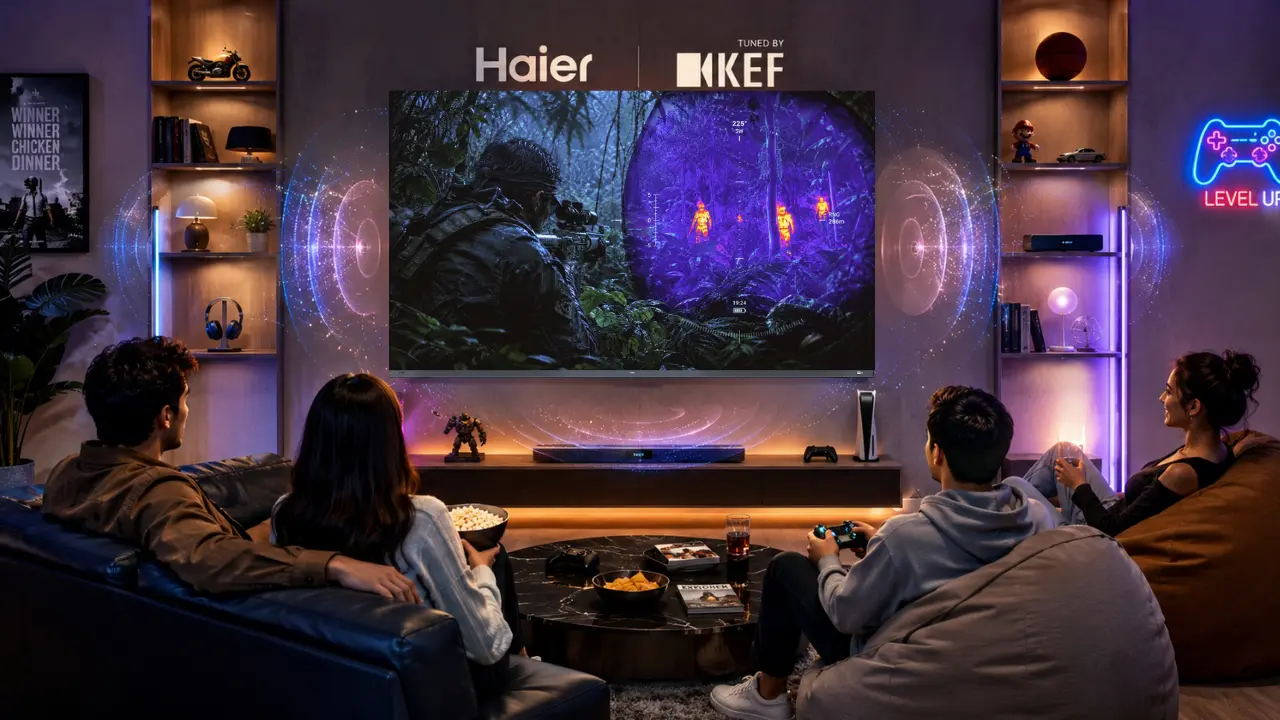

Sound changes how a home feels.
Not just a television.
A home.
The difference between “watching content” and feeling immersed often comes down to audio. A cricket match without crowd depth feels flat. A thriller without atmospheric tension feels forgettable. A concert without layered sound becomes background noise.
That is where KEF-tuned sound in Haier TVs quietly changes the experience.
Haier’s latest QD Mini LED TVs integrate Sound by KEF, Dolby Atmos, dedicated speaker systems, and AI-driven sound optimization to create a more cinematic, emotionally immersive, and balanced listening experience for modern Indian homes.
Most TVs focus on pictures. Great TVs Understand Sound.
Walk into most electronics stores and one pattern appears immediately.
People compare:
- Screen size
- Resolution
- Refresh rate
- Brightness
- Bezel design
Very few people ask about sound seriously.
Until they get home.
Then reality arrives.
Dialogue feels unclear.
Background music overwhelms voices.
Action scenes sound loud but empty.
Sports commentary lacks energy.
The hidden truth is simple.
Humans forgive imperfect visuals faster than bad sound.
A slightly softer image is acceptable.
Muffled dialogue is not.
That matters because modern entertainment is no longer passive.
Indian households today use televisions for:
- IPL streaming
- OTT binge sessions
- Gaming marathons
- Family movie nights
- Music streaming
- YouTube learning
- Festival gatherings
- Weekend house parties
One device now handles multiple emotional environments.
Which means audio cannot remain an afterthought anymore.
What Does “Sound by KEF” Actually Mean?
KEF is globally known for high-fidelity speaker engineering and acoustic research.
When Haier integrates Sound by KEF into its television ecosystem, the goal is not simply louder sound.
It has better sound architecture.
According to Haier’s M92 and M96 QD Mini LED TV series specifications, KEF-tuned sound focuses on:
- Richer sound output
- Clearer vocals
- Better bass depth
- Improved spatial balance
- Greater sound precision
- Immersive multi-dimensional audio
That changes how content behaves inside a room.
Because good sound does not just reach your ears.
It shapes emotional perception.
A whisper feels intimate.
A stadium feels massive.
Rain sounds atmospheric.
Footsteps create tension.
Audio creates emotional geography.
The Real Benefit Is Clarity, Not Volume
Most people assume powerful sound means loud sound.
That is outdated thinking.
The real luxury is clarity.
Especially in Indian homes.
Think about how televisions are actually used:
- Ceiling fans running
- Kitchen sounds nearby
- Traffic outside
- Family conversations happening simultaneously
- Children moving around
- Multiple languages across content platforms
In these environments, dialogue clarity matters more than raw loudness.
This is where KEF-tuned sound becomes practical instead of purely technical.
Why Clear Audio Reduces Mental Fatigue
Poor audio forces the brain to work harder.
People constantly increase volume because speech feels unclear.
Then action scenes suddenly become too loud.
Then volume drops again.
That cycle creates fatigue.
Balanced sound systems solve this invisibly.
Haier’s Sound by KEF integration combined with Dolby Atmos and dedicated speaker systems helps create:
- Better vocal separation
- Cleaner mid-range frequencies
- More stable bass
- Reduced distortion during high-volume scenes
The result feels calmer.
And calm technology often becomes the most loved technology.
Why Sports Feel Bigger With KEF-Tuned Audio
Cricket exposes weak TV sound immediately.
Because sports are not just visual events.
They are atmospheric experiences.
Listen carefully during an IPL match.
The soundscape includes:
- Crowd energy
- Commentary texture
- Bat impact
- Stadium acoustics
- Player communication
- Background chants
Flat speakers compress these layers into noise.
KEF-tuned sound separates them.
That creates depth.
The crowd feels wider.
The comment feels cleaner.
Moments feel more cinematic.
Haier’s M96 Series also includes a 6.2.2 channel speaker setup designed for a more three-dimensional sound field.
That matters because sports immersion is emotional mathematics.
More depth equals more excitement.
Movie Nights Depend More on Audio Than Most People Realise
A horror film without directional sound loses tension.
An action film without bass loses scale.
A romantic scene without musical warmth loses emotional texture.
Cinema has always relied on sound psychology.
Great directors know this.
The door creak matters.
The silence matters.
The distant footsteps matter.
Televisions are increasingly replacing theatre visits for many families.
Especially after OTT platforms reshaped viewing behaviour across India.
But cinematic immersion requires three systems working together:
- Picture depth
- Motion smoothness
- Audio realism
Most TVs prioritise only the first two.
Haier’s KEF-tuned TVs attempt to balance all three.
How Dolby Atmos and KEF Work Together
Dolby Atmos creates spatial positioning.
KEF tuning improves sound fidelity.
Together, they create a more layered experience.
Haier’s M92 Series combines:
- Sound by KEF
- Dolby Atmos
- Total Sonic sound enhancement
- 2.1 channel speaker systems with subwoofers
That combination helps sound move more naturally across scenes.
Not artificial.
Not exaggerated.
Just immersive.
Gaming Reveals Audio Quality Faster Than Movies
Gamers notice sound problems immediately.
Because gaming is interactive.
Latency matters.
Direction matters.
Precision matters.
Footsteps.
Engine sounds.
Gunfire direction.
Environmental audio.
These are functional advantages, not cosmetic ones.
Haier’s QD Mini LED gaming TVs combine:
- 144Hz refresh rates
- VRR
- ALLM
- AMD FreeSync Premium Pro
- KEF-tuned sound systems
That combination matters because immersion breaks when visuals and sound stop syncing emotionally.
Fast visuals with weak audio feel incomplete.
Modern gaming setups increasingly replace traditional entertainment systems inside urban Indian homes.
Especially for Gen Z buyers and young professionals.
The TV is no longer “the family TV.”
It becomes:
- A gaming arena
- A personal cinema
- A music system
- A social gathering point
Sound quality suddenly becomes central to the experience.
The Hidden System: Good Audio Makes Screens Feel Bigger
Here is something most brands rarely explain.
Sound affects perceived screen size.
A television with narrow sound feels smaller psychologically.
Even if the display is huge.
But a wide, room-filling sound creates scale.
This is why theatres feel immersive even before the film begins.
The room disappears acoustically.
KEF-tuned sound helps televisions create that expansion effect.
Especially on larger displays like the:
- Haier New M92 Series 164cm (65) QD Mini LED AI Smart Google TV
- Haier New M92 Series 189cm (75) QD Mini LED Smart AI Google TV
- Haier New M96 Series 254cm (100) QD Mini LED AI Smart Google TV
A bigger screen without immersive sound often feels visually impressive but emotionally flat.
Audio completes scale.
Why Indian Homes Need Smarter Sound, Not Just Louder Sound
Indian homes are acoustically complicated.
Open layouts.
Reflective marble floors.
Compact apartments.
Background appliances running constantly.
That means sound tuning matters more than people realise.
One option is external soundbars.
The second option is expensive home theatre systems.
The third option is televisions designed with better native sound architecture from the beginning.
That third category is growing rapidly because consumers increasingly want:
- Less clutter
- Fewer wires
- Cleaner interiors
- Simpler setups
- Better built-in performance
A television should feel effortless.
That is the hidden expectation shaping premium appliance design today.
Technology Works Best When It Disappears
The best appliance experiences rarely announce themselves loudly.
They simply remove friction.
A refrigerator quietly preserves freshness.
An AC stabilises comfort automatically.
A washing machine reduces mental load.
A great television behaves similarly.
It removes adjustment fatigue.
No constant subtitle dependence.
No volume juggling.
No external speaker dependency for everyday use.
Just smoother immersion.
Haier’s Ultra sense AI ecosystem integrates algorithms across visuals, gaming, sound, and entertainment to create more adaptive viewing experiences.
That matters because modern homes are becoming systems, not collections of disconnected appliances.
The future of entertainment is not individual features.
It is orchestration.
What People Actually Remember About Great TVs
Nobody remembers resolution numbers emotionally.
People remember moments.
The roar during a last-over finish.
The goosebumps during a movie soundtrack.
The bass drops during a concert stream.
The silence before a thriller reveal.
Sound creates memory weight.
That is the deeper role of KEF-tuned sound in Haier TVs.
Not technical superiority alone.
Emotional realism.
And emotional realism is what modern entertainment systems are really competing for now.
Because eventually every screen becomes sharper.
Every processor becomes faster.
Every TV becomes smarter.
But the brands people remember are the ones that make homes feel different.
That is what sound quietly does.
And once people experience better audio properly, ordinary television sound suddenly feels strangely incomplete.
Frequently Asked Questions
Do I really need a TV with premium sound if I mostly care about picture quality?
Yes. While picture quality attracts attention in stores, audio often determines long-term satisfaction at home. Clear dialogue, immersive sports commentary, and cinematic sound effects can dramatically improve everyday viewing.
Is KEF-tuned sound worth paying extra for?
If you regularly watch movies, sports, OTT content, concerts, or play games, KEF-tuned sound can provide better clarity, richer bass, and a more immersive experience without needing external speakers.
Should I buy a TV with better built-in sound or add a soundbar later?
Many users prefer stronger built-in audio because it reduces clutter, wires, and setup complexity. KEF-tuned TVs are designed to deliver a premium experience directly from the TV.
Why do I keep increasing the volume during conversations and lowering it during action scenes?
Many TVs struggle with dialogue separation. Better audio tuning helps voices remain clear while keeping background effects balanced.
Can KEF-tuned sound help me hear voices more clearly?
Yes. One of the primary benefits highlighted is improved vocal clarity and better separation between speech, music, and effects.
Why does TV audio feel exhausting sometimes?
Poor audio often forces your brain to work harder to understand dialogue, especially in noisy environments. Balanced sound reduces this listening fatigue.