
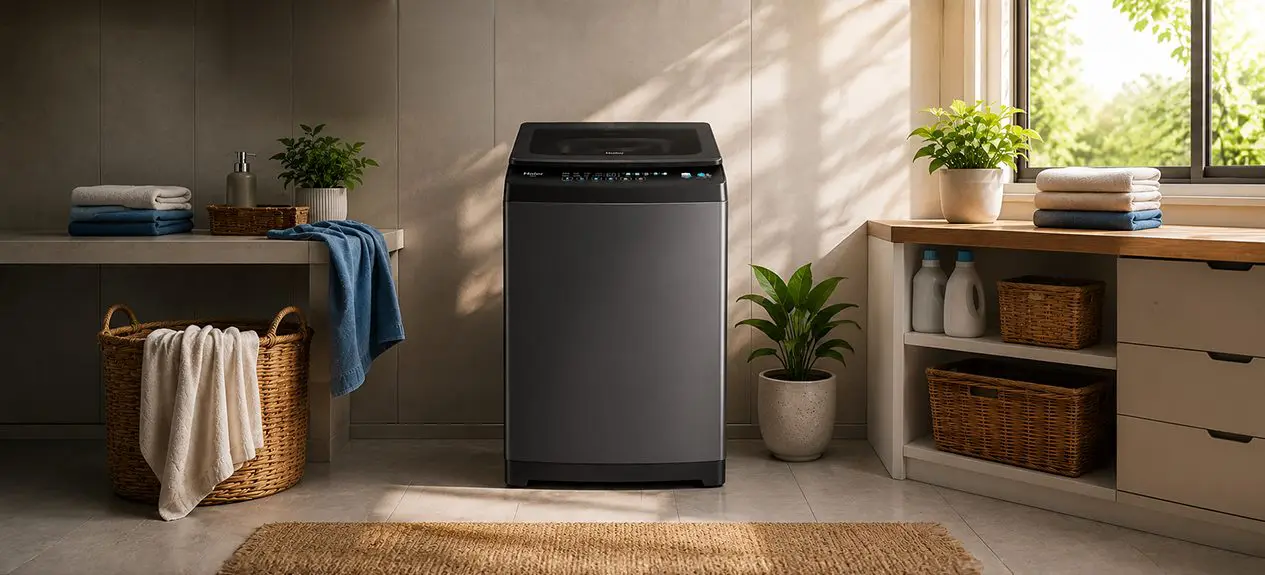

Most Indian households have relied on cold tap water for laundry for decades, drawn straight from the overhead tank or the borewell. This has long been treated as the standard approach. Yet a closer look at appliance specification sheets today reveals a feature that appears with increasing frequency: the built-in heater washing machine. It is often listed alongside spin speed and drum capacity, and many buyers overlook its significance. This deserves closer attention.
A washing machine with a heater is not merely an added convenience. It influences how detergent performs, how stubborn stains are removed, and the overall cleanliness the fabric achieves after a wash. This article examines what the heater actually does, why it holds particular relevance for Indian conditions, and how it fits within a Haier lineup engineered around hygiene and fabric care.
What Is a Built-In Heater and How Does It Work
A built-in heater is a small heating element fitted inside the wash tub. Instead of relying on whatever temperature the tap water happens to be, the machine warms water internally, before or during the cycle. No bucket of hot water gets poured in manually. This differs from a geyser-fed inlet, where hot water enters from an external heater. A built-in unit is self-contained, so it performs the same whether the season is peak summer or a cold January morning.
Detergent chemistry depends on temperature. Enzymes activate faster in warm water. Cold water, especially from underground tanks in winter, often leaves granules partly undissolved, which shows up later as streaks or a stiff feel on dark fabrics. Warmth fixes that at the source.
Advantages of an Internal Heater in a Washing Machine
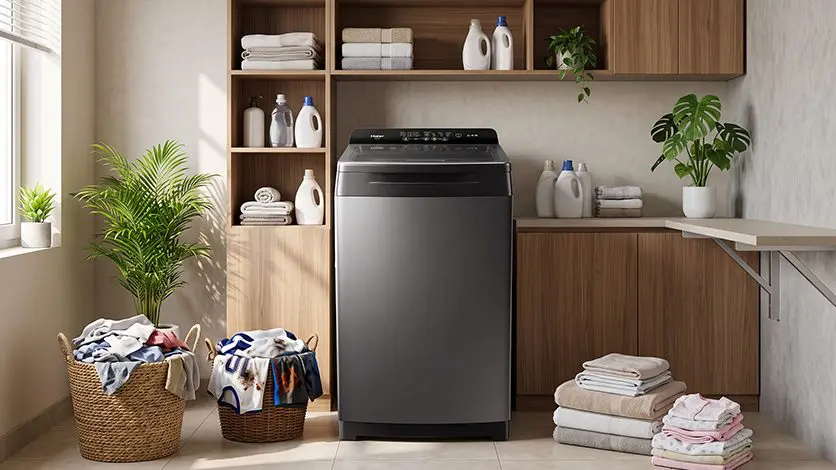
- Better detergent activation. Warm water dissolves detergent evenly, leaving less residue after rinsing.
- Deeper stain removal. Oily stains and sweat marks respond far better to heat. Cold water tends to set them rather than lift them.
- Hygienic wash for specific fabrics. Bedsheets, towels, and baby clothing benefit from a hot cycle that reduces bacteria and dust mites.
- Consistency across seasons. Water temperature swings sharply between May and December. A heater keeps performance steady regardless.
- Less dependence on separate water heating. No manual mixing from a geyser, and no guesswork on getting the temperature right.
This does not mean every wash needs heat. Everyday cottons wash fine cold. The heater works best used selectively, not as a default for every load.
Warm Water Wash Benefits Laundry in Ways Cold Water Cannot Match
Hospitals and commercial laundries almost always wash certain linen in hot water, for good reason. Heat loosens the bond between oily residue and fibres. It also disrupts the environment bacteria and dust mites need to survive. This is where warm water wash benefits laundry stops being a marketing line and becomes something noticeable, usually the first time someone compares a hot-washed towel to a cold-washed one.
| Laundry Type | Cold Wash Result | Hot Wash Result |
| Kitchen towels and dish cloths | Grease often stays behind, look clean but feel stiff | Grease lifts fully, genuinely clean rather than just visually clean |
| School uniforms | Mud and sweat stains partly lift | Stains lift more completely, less pre-treatment needed |
| Bedsheets and towels | Surface rinse only, dust mites largely survive | Actual hygiene reset, bacteria and dust mites reduced |
Hot water is not universally better, though. Wool and silk can lose shape under heat, which is exactly why a heater needs proper fabric-specific programs rather than one fixed temperature. The value depends on how well it pairs with the wash cycle selected.
Why Indian Homes Specifically Need to Think About This
India is not one climate. A machine bought in Kerala works under different water conditions than one in Punjab or Rajasthan. Groundwater in several regions carries mineral content that behaves differently when heated. In colder states during winter, tap water can drop low enough that even good detergents struggle to dissolve in a cold cycle.
There is a hygiene angle too. Dust and humidity levels across most Indian cities stay high for long stretches of the year, so clothes pick up more grime between washes. Households with infants or elderly members often look specifically for a hot wash option because it addresses hygiene needs a purely mechanical cycle cannot fully solve. This is not about hot-washing every load. It is about having the option ready when the situation calls for it, whether that is a monsoon batch of mildew-prone towels or a winter load cold water simply cannot handle.
Do Washing Machines With Heaters Consume a Lot of Electricity
This question stops many buyers from choosing a hot water washing machine, and the honest answer depends on usage. Heating water draws more power than a cold wash; that is basic physics. But the difference is smaller than assumed, since a machine heats a fixed, relatively small volume for a limited duration, not continuously.
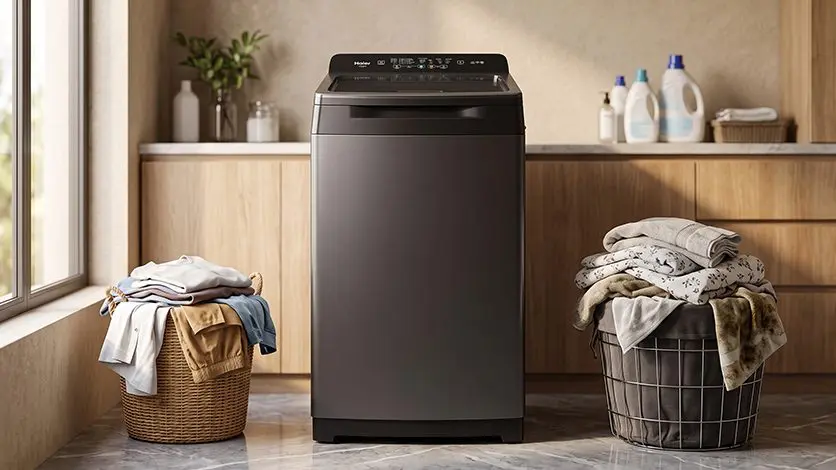
Most machines activate the heater only on specific programs, not by default, so the added draw applies to selected loads rather than every wash. Efficient heating elements also reach target temperature faster and shut off once achieved. Used occasionally, for towels or heavily soiled loads, the added monthly cost stays modest. Treat the heater as a selective tool: everyday laundry runs cold, hot wash gets reserved for loads that genuinely need it.
Haier’s Approach to Heated Wash Technology
Haier’s built-in heater uses a butterfly-shaped element with a longer surface area than conventional designs, so water heats more evenly across the tub instead of in isolated pockets. This uniformity matters because even heating helps detergent activate consistently across the entire load.
We engineered this for the realities of Indian laundry, delivering a cleaner, more hygienic wash on tougher stains and heavily soiled fabrics that a cold cycle typically cannot lift. It supports our stain removal programs too, with dedicated modes for coffee, oil, blood, sweat, mud, and milk stains, each calibrated with the right temperature and wash action.
Our Haier washing machine with heater range spans the top load segment, where models such as the HWM100-H326BK and HWM110-H688BK carry the advanced in-built heater alongside Ultra Fresh Air ventilation and our Magic Filter for lint control. On the front load side, our F-series machines take hygiene further with Steam Wash and Anti-Bacterial Technology (ABT) working alongside heated cycles, so the wash is not just warm but actively sanitising. Hygiene, in an Indian household, is rarely optional, and our machines are built to meet that standard without asking for compromise on convenience.
Explore our front load washing machines for Steam Wash and ABT-enabled hygiene, our top load range for models with the advanced in-built heater, and our semi-automatic washing machines for a simpler wash without heated cycles.
Want to know what causes bad odours in a washing machine and how modern technology prevents them?
Read this blog: Why Washing Machines Develop Bad Odours (And How Modern Technology Helps Prevent Them)
Front Load, Top Load, or Semi-Automatic: Where Does the Heater Fit
| Machine Type | Built-In Heater Available | Typical Hygiene Features |
| Front Load | Yes, on select models | Steam Wash, Anti-Bacterial Technology (ABT), Dual Spray |
| Top Load | Yes, on select models | Advanced In-Built Heater, Ultra Fresh Air, Magic Filter |
| Semi-Automatic | Not available | Anti-Bacterial Pulsator, Magic Filter, manual water control |
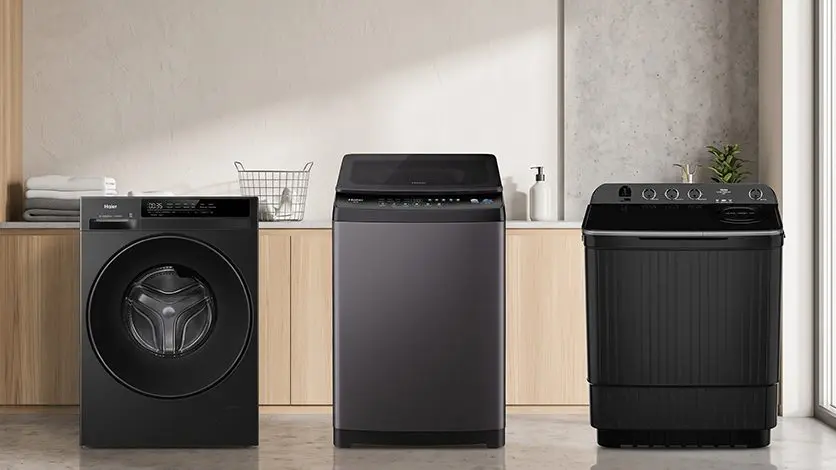
Semi-automatic machines run on a manual, fibre-body construction that does not accommodate an internal heater the way a fully automatic drum does. Anyone running a best washing machine with heater India search should look at the top load or front load categories instead. Front load machines generally pair the heater with steam-based sanitisation, pushing hygiene further, while top load machines with the heater offer that same hot-wash benefit in a more compact, easier-to-operate format.
Conclusion
A built-in heater is not about turning every wash into a hot wash. It is about owning a machine that responds to what a specific load actually needs, whether that is a delicate cotton kurta on a cold cycle or kitchen towels that need real heat to come out properly clean. For Indian households dealing with seasonal water temperature swings, pollution exposure, and a genuine need for hygienic laundry around infants and elderly family members, this feature earns its place rather than sitting there as an upsell. Used sensibly, the electricity cost stays reasonable, and the hygiene benefits are hard to replicate with a cold-only machine. Choosing a washing machine with this capability is less about chasing a trend and more about matching the appliance to the way Indian homes actually do laundry.
FAQs
What is a built-in heater in a washing machine?
It is a heating element fitted inside the machine’s tub that warms tap water internally during the wash cycle. It removes the need to manually add hot water, letting the machine reach the right temperature on its own.
How do Haier washing machines integrate built-in heaters for optimal cleaning performance?
Haier uses a butterfly-shaped built-in heater with a longer heating surface for more even water temperature across the tub. This pairs with dedicated stain-removal programs, so heat and wash action are calibrated together for heavily soiled loads.
Why are built-in heaters considered especially valuable for Indian homes and seasonal needs?
Indian tap water temperature varies sharply by season and region, and detergents dissolve poorly in cold water during winter. A heater keeps wash performance consistent year-round and helps address hygiene needs around dust, pollution, and sensitive household members.
Do washing machines with built-in heaters consume a lot of electricity?
Heating adds some power draw, but only on programs where it is activated, not every cycle. Used selectively, for heavily soiled or hygiene-focused loads rather than daily laundry, the added electricity cost stays modest over a month.
What role do Haier’s Steam Wash and Anti-Bacterial Technology (ABT) play alongside heated washes?
On Haier front-load machines, Steam Wash penetrates fabric fibres with high-temperature vapour to loosen stains and reduce allergens, while ABT targets bacterial growth on wash surfaces. Together, they push hygiene further.