

Washing machines have changed a lot over the years, and the inverter washing machine has become a common choice for many homes. People often notice the term while comparing models, but clear answers are not easy to find. Some guides explain too little, while others make the topic harder than it needs to be.
This blog explains how inverter technology works inside the machine, how it can reduce power use, and why it may last longer. You will also see how Haier uses this technology, making your next buying decision easier.
What Is an Inverter Washing Machine?
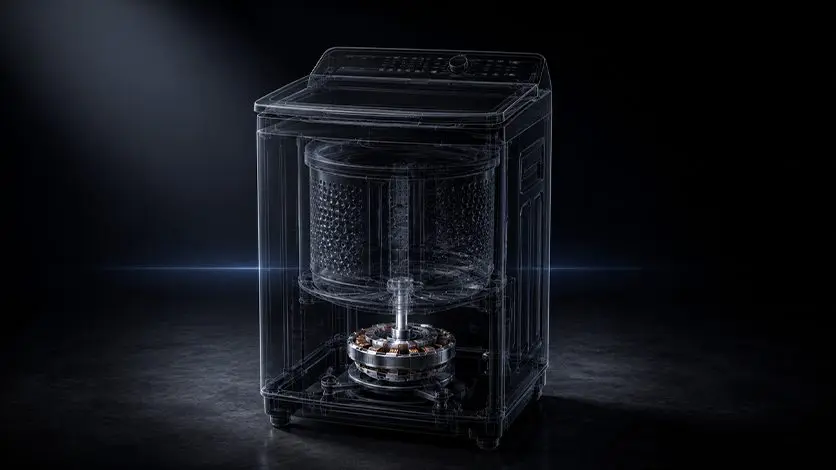
Inverter washing machines use a Brushless DC (BLDC) motor that varies in speed as needed, enabling the machine to be more power-conscious in each wash cycle. Traditional washing machines operate at one speed regardless of the amount of contents in the drum. Inverter motors function differently. They sense the load inside and change the speed and washing power to the type of clothing, fabric and water level. The motor does this by using an electronic control system, resulting in less unnecessary motion and more efficiency overall.
This shift matters a lot more than it initially sounds. Removing brushes and belts means fewer moving parts that wear out through friction. Haier’s Direct Motion Motor, used across several front-load ranges, connects the motor shaft directly to the drum. No belt sits between them, so there is nothing to snap, stretch, or slip over years of daily use.
What Is Inverter Technology in a Washing Machine?
At its core, this comes down to one idea: precision control over the power supply. A regular AC motor draws a fixed frequency of current and spins at a fixed rate, always. An inverter system takes that incoming AC power, converts it to DC, then reconverts it back to AC at a frequency the machine’s control board decides in real time. This lets the drum spin gently for delicate fabrics and forcefully for heavier loads, all within the same wash cycle, without a person adjusting any dial manually.
The practical result is a machine that senses rather than assumes. A 3 kg load of shirts and a 9 kg load of towels get treated differently because the motor’s electronics are constantly reading and reacting to what’s inside.
Why This Changes Your Laundry Routine
The benefits are not just technical trivia, they show up in everyday use.
- Lower noise levels: Without belt or brush friction, inverter motors run noticeably quieter, even during high-speed spin cycles.
- Reduced vibration: Direct-drive inverter motors sit closer to the drum, cutting down the wobble older machines are known for.
- Better energy efficiency: Since the motor adjusts speed instead of always running at full power, it draws only as much electricity as the load genuinely needs.
- Longer motor life: Fewer mechanical parts in contact mean less wear, which is why several inverter motors now carry extended warranties running into a decade or more.
- Gentler fabric care: Variable torque control means delicate clothes aren’t spun at the same aggressive speed as heavy denim or bedsheets.
Together, these advantages are what turn a regular machine into a smart inverter washing machine, one that reacts to your laundry instead of running on a fixed timer.
Conventional Motor vs Inverter Motor: A Quick Comparison
| Parameter | Conventional Motor | Inverter Motor |
| Speed control | Fixed, single speed | Variable, based on load |
| Noise level | Higher | Noticeably lower |
| Vibration | More noticeable | Reduced |
| Energy use | Constant, regardless of load | Adjusts to actual load |
| Moving parts | Belt, brushes, pulley | Direct drive, fewer parts |
| Typical warranty | Shorter | Often longer, sometimes lifetime |
Where Inverter Technology Fits: Front Load, Top Load, and Semi-Automatic
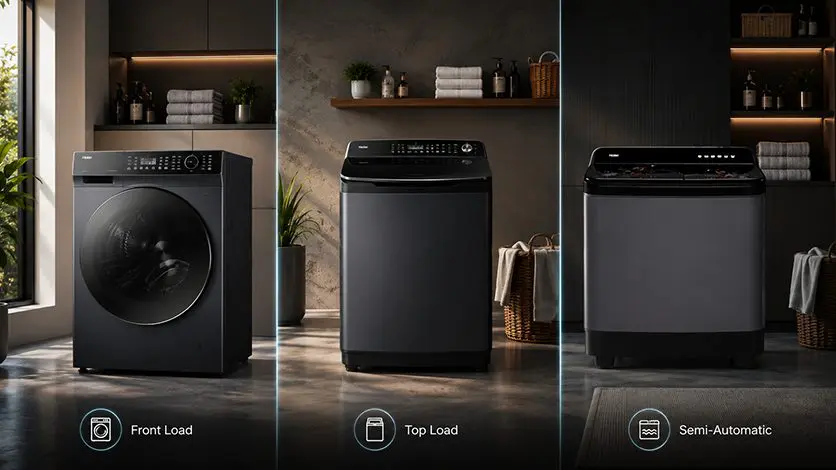
Not every washing machine format runs on inverter tech, and that’s fine, since each one serves a different household need.
Haier’s front-load washing machines carry the Direct Motion Motor most consistently. Models like the Haier 12 Kg F11 Front Load Washer & Dryer and the Haier 12 Kg F9 Front Load Washing Machine pair this motor with a 525mm super drum that gives clothes more room to move without tangling. The Haier F5 10KG Front Load Washing Machine carries the same inverter drive into a slightly smaller footprint, along with AI Wash, which reads load weight automatically, and Essence Wash, which pre-mixes detergent before spraying it onto fabric for a faster, deeper clean.
Top Load Washing Machines from Haier lean on a slightly different mix, fuzzy control logic that senses water level by weight, paired with an in-built heater for hot wash cycles and Oceanus Wave Drum technology that mimics the motion of a hand wash. The Haier 11KG Top Load Washing Machine (HWM110-H688BK) and the Haier 10KG Top Load Washing Machine (HWM100-H326BK) carry this combination along with AI Wash sensing, extending the smart layer even where the drive mechanisms are more conventional.
Semi-automatic washing machines, on the other hand, are built around manual assistance and simplicity. Models like the Haier Semi Automatic Washing Machine 12 KG 196BK run on the Thunder Pulsator, while the Haier Semi Automatic Washing Machine 11 KG 178FLN is built around the Vortex Pulsator, both designed for straightforward wash-rinse-spin operation without the electronics an inverter system needs. For households wanting a no-fuss machine with a smaller footprint, this segment still holds strong.
How We Think About Motors at Haier
We have spent years refining what a washing machine motor should actually do, and our answer keeps coming back to one principle: fewer parts that can fail, and more intelligence in how the machine responds to what you put inside it.
Our Direct Motion Motor removes the belt-pulley system entirely, connecting the motor straight to the drum. This is why several of our front-load models, including the F9, F11, and F17 series, run with far less vibration than machines built around older mechanics. We back this with extended motor warranties because a beltless design genuinely holds up longer under daily washing.
Want to know if a direct motion motor is actually worth the upgrade over a regular one? Read this blog: Is a Direct Motion Washing Machine Really Better?
We also don’t believe smart features and motor design should live in separate conversations. Our smart inverter washing machine models pair the Direct Motion Motor with AI Wash, Smart Dosing, and Essence Wash, so the machine isn’t just spinning efficiently, it’s also deciding how much detergent, water, and time a load actually needs. That combination is what we mean when we talk about washing machines built around how Indian households actually do laundry, not just how a lab test measures it.
Conclusion
Choosing between a conventional motor and an inverter one isn’t about chasing every new feature on a spec sheet. It’s about how often you do laundry, how much noise your home can tolerate, and how long you expect the machine to last without a service visit. An inverter washing machine tends to answer all three of these questions better than an older belt-driven design, which is why the category keeps growing across Indian homes.
Frequently Asked Questions
What does digital inverter mean?
A digital inverter refers to a motor control system that converts AC power to DC and back to AC at a frequency decided by an onboard chip. This lets the motor’s speed adjust in real time, rather than running at one fixed rate.
Is an inverter washing machine better than a non-inverter one?
In most cases, yes, since inverter motors run quieter, use less electricity for smaller loads, and last longer due to fewer moving parts. Non-inverter machines can still work fine for basic, low-frequency laundry needs.
Can a washing machine run on an inverter (power backup)?
Yes, most washing machines, including inverter-motor models, can run on a home power inverter, provided the backup unit’s load capacity matches the machine’s wattage. Always check your inverter’s rated output before running heavy appliances on it.
Do inverter washing machines really save electricity?
Yes, because the motor adjusts speed and power draw based on load size instead of always running at full capacity. Over months of regular washing, this adds up to a noticeably lower electricity bill.