
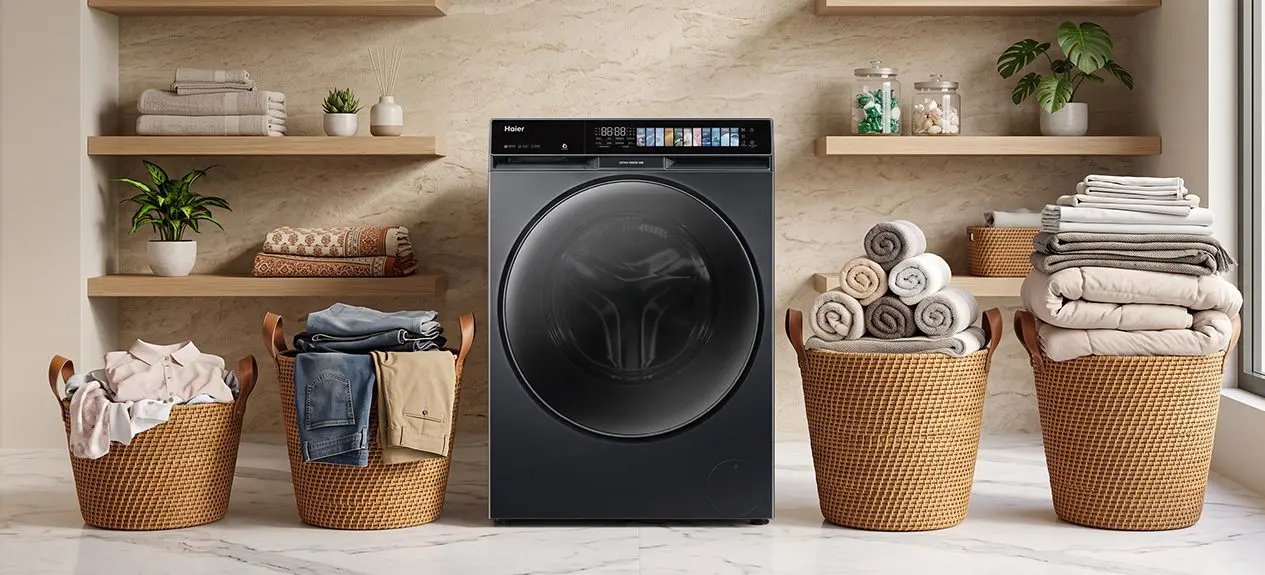

Buying a washing machine appears straightforward until the capacity filter shows numbers like 7kg, 8kg, 10kg, or 12kg, and most buyers are left unsure which one to choose. Many end up deciding based on what a neighbour owns or what fits the budget, without really considering the household’s actual laundry load. Getting this number right matters more than most buyers realise. It determines how many loads run each week, how much water and electricity get consumed, and whether garments actually come out clean.
Consider this a proper washing machine size guide, covering what each size holds, who it suits, and how Haier builds machines around these exact numbers.
What Does Washing Machine Capacity Actually Mean?
Capacity is the maximum weight of dry clothes a machine can wash in one cycle, not wet ones, and not a stack eyeballed from the cupboard. A 7kg machine takes 7kg of dry laundry, no more, even when there looks to be room left in the drum. Overloading strains the motor, leaves clothes half rinsed, and wears the drum bearings down faster than they should. Underloading isn’t great either, since a half-empty drum wastes water and power for no real benefit. The drum size, motor strength, and water inlet are all engineered around this single number, so capacity really describes the machine’s entire working limit, not just a figure on a spec sheet.
Washing Machine Size Guide: Matching Capacity to Household Size
Every household has its own laundry rhythm, and that’s exactly what this washing machine size guide accounts for. Below is a rough breakdown based on typical Indian family sizes and weekly wash habits, useful as a starting point before narrowing down a model.
| Capacity | Best Suited For | Approx. Items Per Load |
| 7kg | Singles, couples, or small families of 2-3 | Around 25-28 garments, daily wear and light towels |
| 8kg | Families of 3-5 with regular laundry needs | 30-35 items including bedsheets and towels |
| 10kg | Larger families of 5-7, frequent washing | 40-45 items, mixed fabrics and heavier loads |
| 12kg | Big or joint families, bulk laundry, curtains, blankets | 50 or more items in a single cycle |
These numbers shift depending on fabric type too, denim weighs more than cotton t-shirts, so a drum packed with jeans hits its weight limit before it actually looks full.
Want a deeper breakdown of which capacity suits apartments, villas, or joint families?
Read this blog: Best Washing Machine Configurations for Apartments, Villas, and Large Families
What Fits in a 7kg Washing Machine?
A 7kg drum comfortably handles daily office wear, casual t-shirts, undergarments, and a couple of hand towels per cycle. It’s the size most single professionals or young couples in apartments choose, mainly because it stays compact and doesn’t eat up floor space. It won’t manage a heavy bedsheet alongside a full load though, so wash days need a bit more planning. Haier’s 7kg top load range covers this segment well, good for buyers wanting a small footprint without giving up daily wash convenience.
What Fits in an 8kg Washing Machine?
Step up to 8kg, and the machine starts handling proper family laundry: shirts, trousers, a couple of bedsheets, and kitchen towels, all in one go. This is arguably the most commonly bought size across urban Indian homes, sitting right at the point where convenience meets practicality. Haier’s 8kg range spans front load, top load, and semi-automatic categories, so buyers pick based on load type preference instead of being boxed into one format.
What Fits in a 10kg Washing Machine?
A 10kg machine is where things get genuinely spacious. Think mixed loads of adult and children’s clothing, multiple bedsheets, curtains on occasion, and towels for an entire household in one cycle. Families that wash less often but in bulk, twice a week instead of daily, tend to land here. It also suits homes running delicate and heavy fabrics together, since there’s enough drum room for clothes to move freely instead of clumping. Haier’s 10kg lineup includes a front load option and a top load model, so the choice comes down to preferred load type rather than availability.
What Fits in a 12kg Washing Machine?
This is the largest of the four, built for joint families, hostels, or homes that generate a lot of laundry. A 12kg drum can take a full week’s clothing for a family of six or more, plus heavier items like blankets and thick towels that would otherwise need a separate wash. Haier’s F9, F11, and F5 series all offer 12kg front load variants, and the semi-automatic range extends up to 14kg for households needing even more room.
Front Load, Top Load, or Semi-Automatic: Does Load Type Change Capacity?
The kg number stays the same across formats, but how efficiently a machine uses that capacity depends on load type. Front load machines generally clean more thoroughly at the same capacity, since clothes tumble through less water aided by drum design. Top load machines are quicker to load and unload, better suited to households in a hurry most mornings. Semi-automatic machines need manual water filling and draining, but they cost less to run and work fine even with irregular supply, fairly common across Indian neighbourhoods. Picking the correct washer size, then, isn’t only about counting family members, it’s also about matching capacity to the format that suits daily routine.
How Haier Builds Around Every Capacity
At Haier, we don’t treat capacity as just a number on a spec sheet. Every drum we design, from compact 7kg options to our 12kg and 14kg large-capacity machines, is engineered to use that space efficiently rather than just hold it. Our front load range, including the F9, F11, and F5 series, comes with a 525mm Super Drum and Direct Motion Motor, so clothes move freely instead of bunching up during a full load. Ultra Fresh Air keeps the drum dry and odour-free between washes, while AI Wash reads the load weight automatically and adjusts water and detergent accordingly, handy when you’re not sure how full that drum really is. In our top load range, the Oceanus Wave Drum and Butterfly Heater work together for a deeper hot wash across 7kg to 12kg capacities, and toughened glass lids are built to take daily use for years. Our semi-automatic machines, going up to 14kg, come with Anti-Rat Mesh, Magic Filter, and castor wheels as standard, practical additions for larger families wanting dependable, no-fuss washing. Whatever capacity fits your household, we’ve tried to make sure the machine performs at that size, not merely holds it.
Choosing the Right Washer Size for Your Home
A few honest questions help more than any spec sheet. How many people actually live at home, and how quickly does the laundry basket fill up during the week? Some households wash daily in small batches, others save it up and do a bulk wash twice a week instead. Space also matters, a compact utility area needs a different machine than a full laundry room does. Answer these first, and the right washer size becomes obvious faster than comparing kg numbers ever will.
Match load type, front, top, or semi-automatic, to your daily routine and water supply
Conclusion
Capacity isn’t a detail to skim past while buying a washing machine, it shapes water use, wash time, and how well clothes actually come out. A 7kg machine suits solo living or small families well, 8kg covers most urban households comfortably, and 10kg to 12kg options exist for families with heavier laundry demands. Whichever size works for your home, understanding what it actually holds saves you from running too many cycles or paying for space you’ll never use.
FAQs
What does washing machine capacity actually mean?
It refers to the maximum weight of dry clothes a machine can wash safely in one cycle. A 7kg machine takes 7kg of dry laundry, not wet clothes, and overloading beyond this limit affects wash quality and machine life
How to choose washing machine capacity?
Base it on household size and laundry frequency first. Small families suit 7-8kg, larger households need 10-12kg. Also factor in bulky items like bedsheets or curtains, plus available floor space, before finalising a model.
Is buying a larger-capacity washing machine always better?
Not necessarily. A bigger drum for a small household usually means running partial loads, wasting water and electricity each cycle. Matching capacity to actual laundry volume works better than simply buying the largest size available.
Does washing machine capacity affect water and electricity consumption?
Yes, larger capacity machines use more water and power per full cycle, but running fewer loads on the correct size machine can work out more efficient overall than repeatedly running a smaller one at full stretch.