
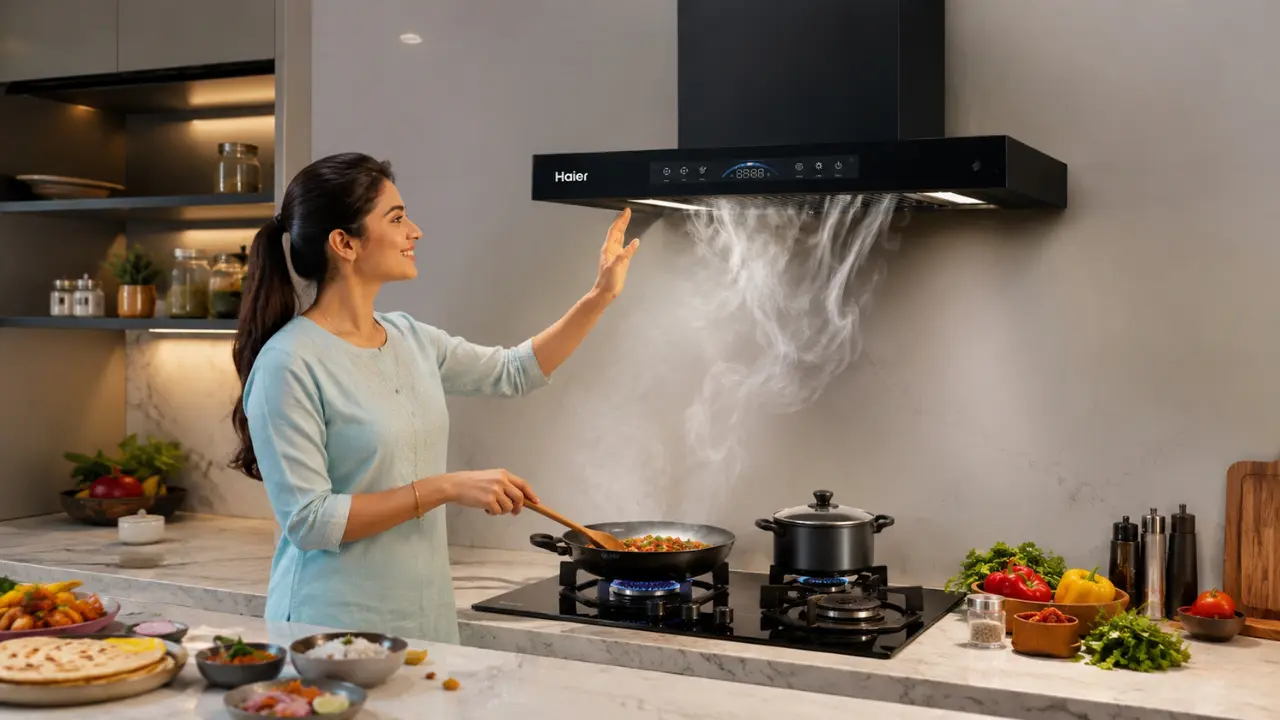

The modern Indian kitchen is no longer just a cooking space
It is a heat zone. A conversation zone. A multitasking zone.
Someone is frying tadka while attending a work call. Someone is reheating leftovers at midnight after a long commute. Someone else is making Sunday biryani while children run through the house.
And yet, many kitchens still operate like they did fifteen years ago.
Smoke hangs in the air. Oil settles on cabinets. Heat builds up silently. Exhaust fans struggle. Windows stay open even during peak summers.
A smart kitchen chimney changes that equation.
Not because it looks modern. Because it changes how the kitchen behaves.
The future of cooking is not just about better recipes. It is about cleaner air, quieter systems, easier maintenance, and appliances that understand how Indian homes actually function.
That shift has already begun.
Indian cooking creates a different kind of kitchen challenge
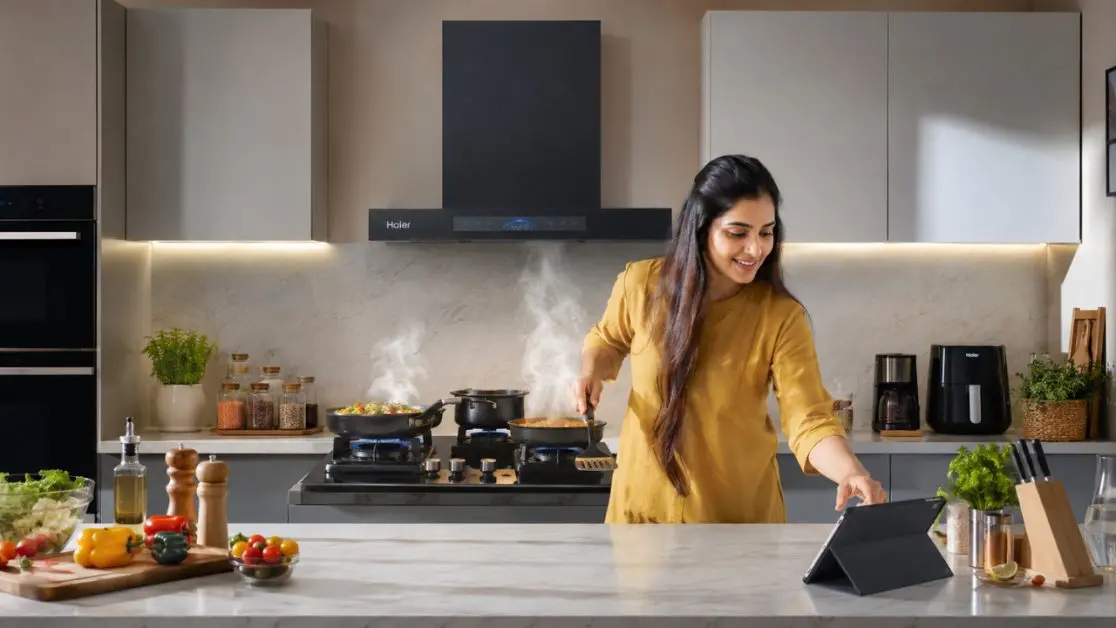
Most global kitchen designs underestimate Indian cooking.
Our kitchens deal with:
- Deep frying
- High-temperature tadka
- Heavy masala cooking
- Long simmering
- Multiple burners running together
- Oil-heavy festive cooking
This creates three invisible problems.
Problem one: Air quality declines quietly
Cooking smoke contains grease particles, odours, and airborne pollutants. Over time, they settle into curtains, walls, cabinets, and even upholstery.
The kitchen stops feeling fresh long before people notice why.
Problem two: Heat changes behaviour
A hot kitchen changes how long people want to cook.
It affects comfort. Energy. Patience.
That matters more today because modern homes are becoming increasingly compact.
Problem three: Cleaning becomes a second job
Traditional chimneys often demand constant filter cleaning.
And here is the hidden truth:
An appliance that requires too much maintenance eventually gets ignored.
That is why smart kitchen chimneys are becoming less of a luxury and more of a systems upgrade for modern Indian households.
The smartest appliances remove friction first
Technology matters. But invisible convenience matters more.
A smart chimney succeeds when it removes tiny daily irritations people have normalized for years.
What modern smart chimneys are solving
One option is stronger suction power.
Another option is quieter operation.
The third option is reducing maintenance entirely through filterless systems and heat auto-clean technology.
Together, these features change the rhythm of cooking.
For example, several modern Haier kitchen chimneys now feature high suction capacities ranging from 1500 m³/h to 1600 m³/h, designed specifically for heavy Indian cooking conditions.
That matters during:
- Fish frying
- Multiple rotis on the tawa
- Festival cooking sessions
- Weekend family meals
- Open kitchen entertaining
Because smoke control is not cosmetic anymore.
It affects comfort across the entire home.
The future kitchen responds without interrupting you
Think about how people interact with appliances today.
Nobody wants complexity at 8:30 PM after work.
Nobody wants buttons covered in oil stains.
Nobody wants another instruction manual.
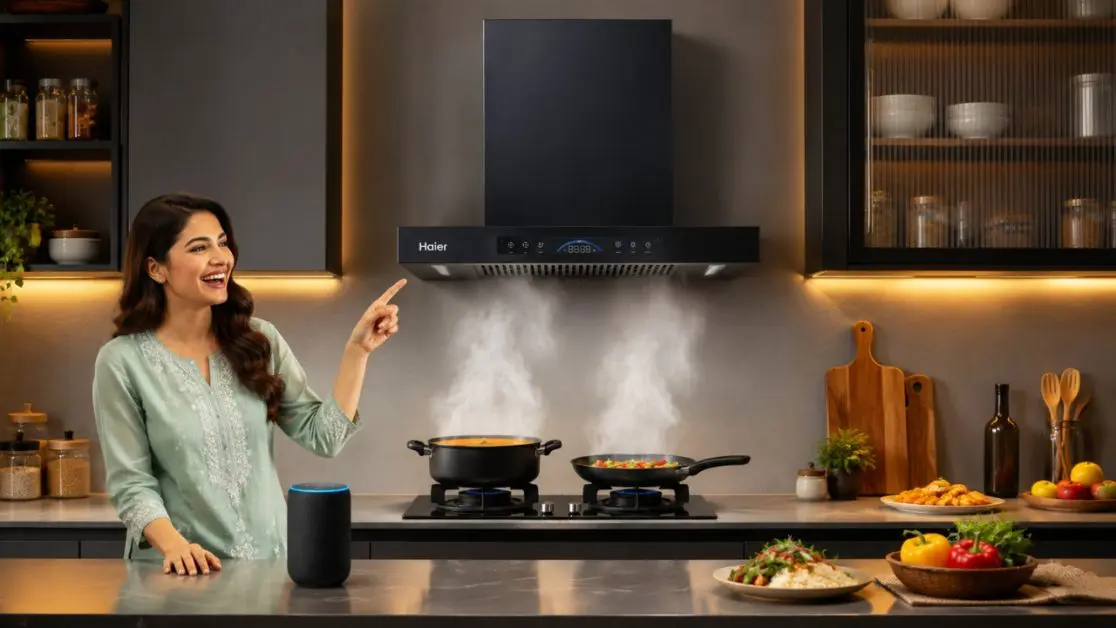
That is why gesture control is quietly becoming important.
Touch and gesture controls are solving a real-world problem
Modern smart chimneys increasingly include touch and gesture operations for hands-free control.
At first glance, it sounds like a premium feature.
But the real value is practical.
Your hands are wet. Oily. Covered in atta.
A simple gesture becomes easier than touching controls repeatedly.
Small convenience. Big behavioural shift.
That is how future appliances win.
Not through complexity. Through reduced interruption.
Filterless chimneys reveal a larger pattern in appliance design
The biggest innovation in home appliances often sounds boring.
Until you live with it.
Filterless chimneys are a good example.
Traditional filters trap grease. Over time, they clog. Airflow drops. Cleaning increases.
Filterless systems change that structure entirely.
Why filterless systems matter
Modern Haier chimneys like the HIH-T1600-IN and HIH-G1750-IN use filterless designs combined with heat auto-clean functionality.
The result is simpler maintenance.
Less dismantling.
Less manual cleaning.
Less frustration.
And there is a larger principle hiding underneath this trend:
The future of appliances is lower cognitive load.
The best technology removes tasks from your life instead of adding new ones.
Heat auto-clean is not just about hygiene
It is about consistency.
Many appliances work brilliantly during the first six months.
Then performance drops because maintenance becomes irregular.
Heat auto-clean systems help reduce grease accumulation by melting and collecting oil residues internally.
That creates two long-term benefits:
- Better sustained suction performance
- Better hygiene over time
And in Indian homes, consistency matters more than novelty.
Because cooking is daily.
Not occasional.
Noise changes how a home feels
Most people underestimate appliance noise until they experience quieter systems.
A loud chimney changes conversation.
It changes TV volume.
It changes how open kitchens feel.
The rise of BLDC motor technology
Some modern smart chimneys now include BLDC motors designed for lower noise and higher efficiency.
For example:
- HIH-T1900-BLDC-IN features noise levels below 48 dB with 1600 m³/h suction power.
- HIH-T1600-BLDC-IN combines BLDC efficiency with multiple speed controls and gesture operation.
That balance matters.
Because powerful suction without unbearable noise changes the experience completely.
A kitchen should feel active. Not industrial.
Smart kitchens are becoming emotional spaces
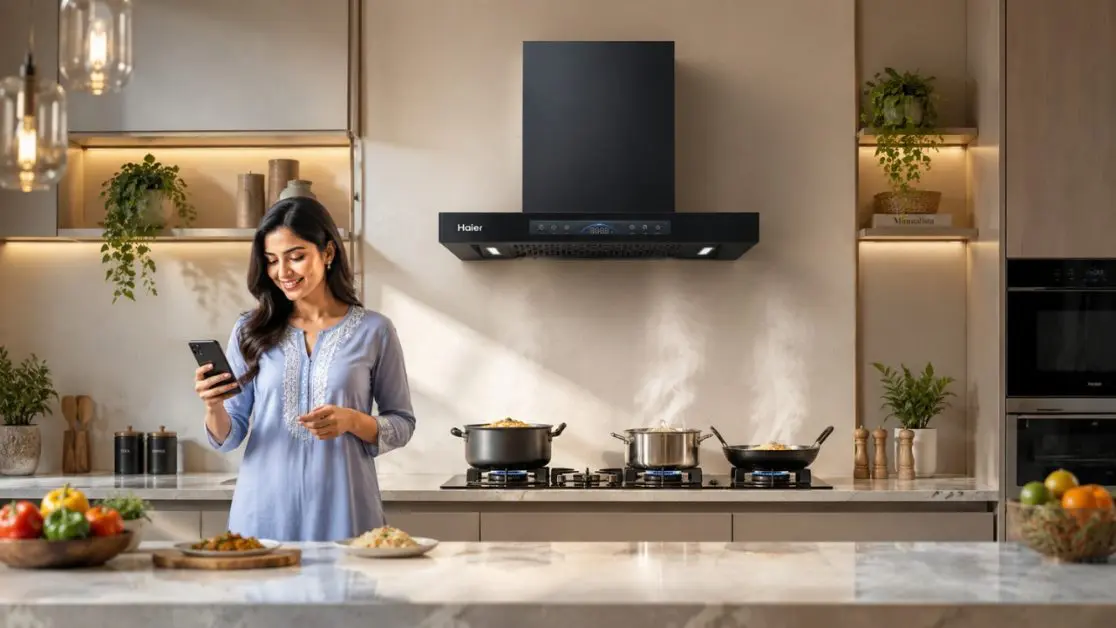
This shift is bigger than technology.
Earlier, kitchens were hidden utility zones.
Now they are increasingly visible.
Open kitchens changed everything.
Today, kitchens appear in:
- Family conversations
- House parties
- Instagram stories
- Video calls
- Festive gatherings
The kitchen became part of the home’s identity.
Which explains why appliance aesthetics matter more now.
Design is no longer separate from functionality
Modern chimneys increasingly use:
- Black glass finishes
- Arc glass styling
- Minimal touch panels
- Slim T-shape structures
Not to impress guests.
To reduce visual chaos.
A calm-looking appliance creates a calmer-looking kitchen.
That sounds subtle. It is not.
Homes shape mood through accumulated details.
The future of cooking is also about energy behaviour
Indian households are becoming more energy-aware.
Not necessarily because people suddenly love efficiency.
Because electricity costs rise. Summers intensify. Appliance usage increases.
That changes buying behaviour.
People now evaluate appliances differently
Earlier, purchase decisions focused mostly on upfront pricing.
Now people evaluate:
- Maintenance requirements
- Long-term efficiency
- Noise levels
- Durability
- Warranty support
- Ease of cleaning
This is where smart chimney systems with BLDC motors and lower maintenance structures begin to stand out more meaningfully.
A cheaper appliance that becomes irritating after one year is rarely economical.
The hidden cost of bad design is daily annoyance.
A smart chimney quietly changes household behaviour
This is the interesting part people rarely discuss.
When kitchens become cleaner and less exhausting, cooking behaviour changes too.
People experiment more.
Families cook together more comfortably.
Open kitchens feel usable during gatherings.
Late-night cooking feels less chaotic.
The appliance disappears into the experience.
And that is usually the sign of good design.
Not paying attention.
Absence of friction.
Why this shift matters for modern Indian homes
India is entering an era of smarter domestic infrastructure.
Not just smart phones. Smart living systems.
The appliances people choose today increasingly shape:
- Indoor comfort
- Air quality
- Daily energy use
- Cleaning workload
- Household routines
- Emotional atmosphere
Kitchen chimneys sit at the center of that transition because cooking remains deeply emotional in Indian culture.
Food is memory.
Food is hospitality.
Food is routine.
And every system around cooking affects how people experience home itself.
That is why smart kitchen chimneys are not simply about suction power anymore.
They represent something larger.
A move toward homes that support people quietly.
Without demanding attention every hour.
Without creating unnecessary friction.
Without turning maintenance into labour.
The future kitchen is not louder. Or flashier.
It is calmer.
Cleaner.
More responsive.
And perhaps that is the real lesson modern appliances are teaching us:
The best technology does not dominate the room. It gives people more room to live.
Frequently Asked Questions
Do I really need a smart kitchen chimney, or is a regular chimney enough?
If you frequently cook Indian food involving frying, tadka, grilling, or multiple burners, a smart chimney can significantly improve air quality, reduce grease buildup, and lower maintenance compared to traditional models.
How do I know if my current chimney is underpowered?
Signs include lingering cooking smells, visible smoke during cooking, greasy cabinets, and heat accumulation even when the chimney is running.
Is higher suction power always better?
Not necessarily. Higher suction is useful for heavy Indian cooking, but factors like noise levels, energy efficiency, and kitchen size also matter.
Should I prioritize suction power or low noise?
Ideally both. Strong suction removes smoke effectively, while lower noise levels make the kitchen more comfortable for daily use.
Is a smart chimney worth the extra cost?
For households that cook regularly, the reduced cleaning effort, improved comfort, and better long-term performance often justify the investment.