
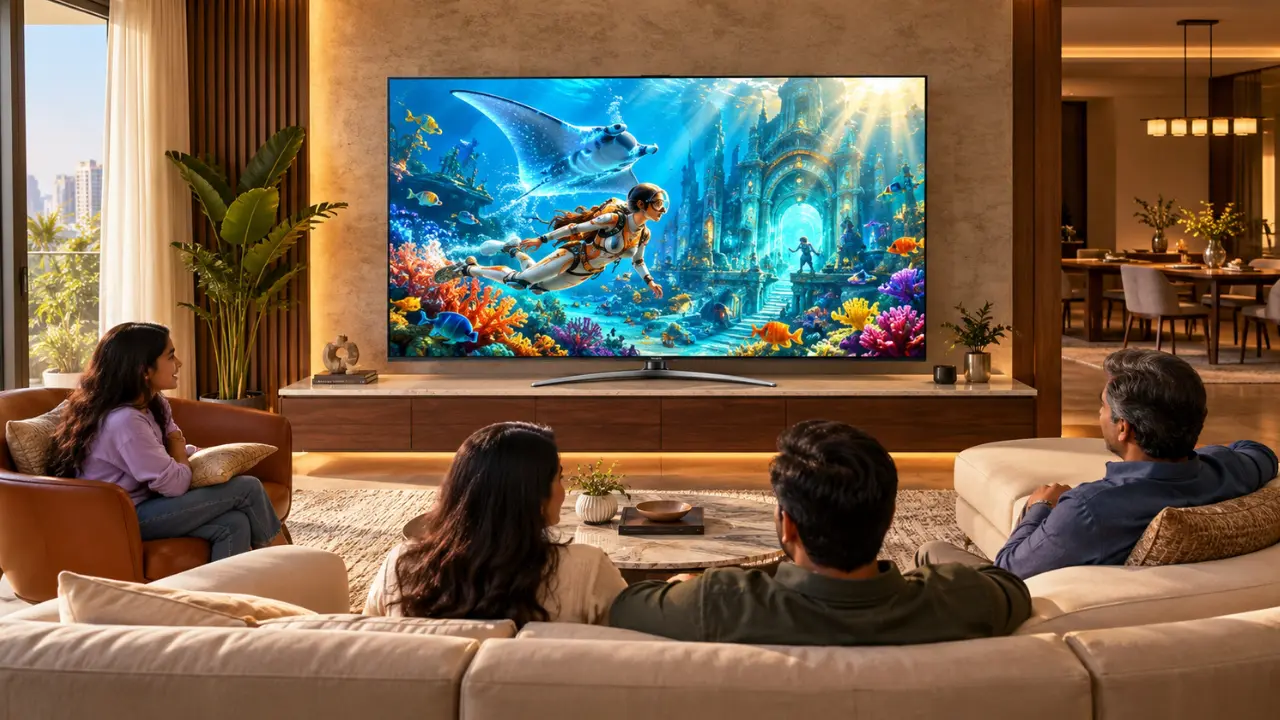

Two televisions. Same screen size, same 4K resolution, and almost identical specifications. Yet, when you watch them side by side, one produces noticeably deeper blacks while the other maintains its colours better when viewed from an angle.
What’s making the difference?
Quite often, it’s the display panel.
When comparing VA vs IPS TV display panels, the choice comes down to how you watch television and, more importantly, where you sit. A family watching cricket from different corners of a large living room may have different requirements from someone enjoying films in a dimly lit bedroom.
Neither technology wins every comparison. Understanding their strengths can help you choose a television that genuinely suits your home.
What Is the Difference Between VA and IPS TV Panels?
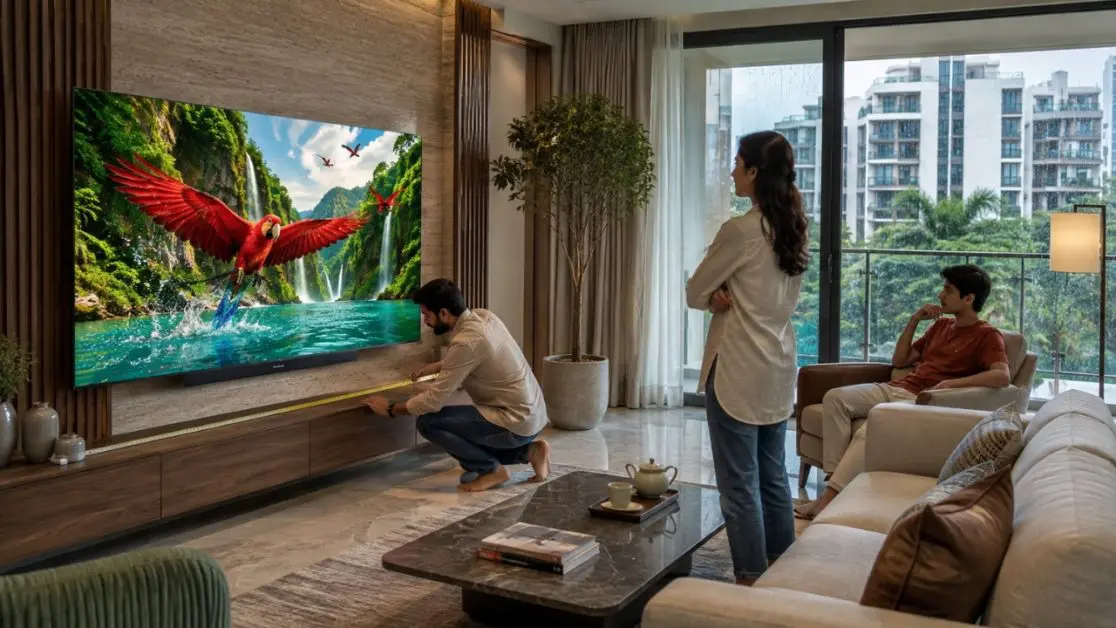
VA (Vertical Alignment) and IPS (In-Plane Switching) are two types of LCD panel technology used in LED-backlit televisions.
Both control how light passes through liquid crystals to create images. However, the arrangement and movement of those crystals differ, influencing contrast, black levels and viewing angles.
How Does a VA Panel Work?
In a VA panel, liquid crystals align predominantly vertically when no voltage is applied. This arrangement helps block light more effectively, producing darker blacks.
When electricity passes through, the crystals tilt to allow different amounts of light through.
The result? Stronger native contrast.
VA panels generally offer:
- Deeper black levels during dark scenes.
- Higher native contrast than conventional IPS panels.
- Better performance for viewers sitting directly in front.
- More noticeable colour and contrast changes at wider angles.
Imagine watching a suspense thriller at night. Those shadowy corridors and dimly lit rooms can appear more convincing on a good VA display.
How Does an IPS Panel Work?
IPS technology arranges liquid crystals so they rotate largely within the plane of the display.
This structure helps maintain more consistent colours and brightness when viewed from different positions.
Its biggest advantage is flexibility.
IPS panels generally provide:
- Wider usable viewing angles.
- More consistent colours when viewed from the sides.
- Better suitability for spread-out seating arrangements.
- Lower native contrast compared with typical VA panels.
The trade-off becomes noticeable during dark scenes, particularly in rooms with minimal lighting.
Which Panel Performs Better in Different Rooms?
Here’s where the comparison becomes interesting. The better panel isn’t necessarily the one with the most impressive specifications.
It’s the one that works with your room.
1. Living Rooms With Multiple Seating Positions
Picture a typical Indian living room.
There’s a three-seater sofa opposite the television, an armchair near the window, and perhaps a dining area from which someone occasionally watches the news.
Not everyone enjoys the perfect centre position.
An IPS panel can be advantageous because it generally maintains picture consistency across wider viewing angles.
Consider IPS when:
- Family members frequently watch together.
- Seating extends towards the sides.
- Your television is visible from the dining area.
- You regularly entertain guests.
However, viewing-angle performance varies between individual televisions. Some VA models also incorporate technologies designed to improve off-centre viewing.
2. Bedrooms With Straight-On Viewing
Bedrooms usually have a simpler seating arrangement.
The television sits opposite the bed, and most viewing happens from a relatively fixed position.
Here, a VA panel’s stronger native contrast can become particularly useful.
Watching a film with the lights dimmed? Darker blacks can make the picture appear more immersive.
For bedrooms where viewers sit almost directly opposite the screen, VA technology is often worth considering.
3. Bright Rooms With Large Windows
A sunlit living room introduces another challenge.
Reflections.
Although IPS panels generally maintain better off-axis consistency, that doesn’t automatically make them superior in bright environments.
A television’s peak brightness, anti-reflection treatment and screen finish can matter more than its panel type.
Before purchasing, consider:
- Whether sunlight falls directly on the screen.
- The position of windows relative to the television.
- How effectively the display handles reflections.
- Whether picture brightness remains comfortable during daytime viewing.
A bright television with good reflection handling may outperform a less capable model regardless of whether it uses VA or IPS technology.
Does VA or IPS Offer Better Picture Quality?
Picture quality involves considerably more than panel construction.
Contrast and Black Levels
VA panels generally have the advantage in native contrast.
A conventional VA LCD panel may offer contrast ratios around 3,000:1 to 6,000:1, while many conventional IPS LCD panels fall closer to 1,000:1.
These are broad technology-level ranges, not guaranteed specifications for every television.
Actual performance depends on panel design, backlighting and picture processing.
Colour Reproduction
IPS panels are often associated with colour consistency across wider angles.
However, that doesn’t mean VA panels cannot reproduce accurate colours.
Colour gamut, calibration, processing and display technology all influence the final result.
A well-calibrated VA television can produce excellent colours, particularly when viewed directly.
Motion and Gaming
Another common misconception is that IPS panels are automatically faster.
Modern televisions are more complicated than that.
For gaming and sports, examine:
- Refresh rate: Determines how frequently the display updates its image.
- Response time: Influences motion blur and pixel transitions.
- Input lag: Affects how quickly actions appear on screen.
- VRR support: Helps synchronise compatible gaming devices with the display.
Panel technology can influence motion performance, but it doesn’t determine the complete gaming experience.
How Do QLED, Mini LED and OLED Fit Into This Comparison?
This is an important distinction because television terminology can become confusing.
VA and IPS describe LCD panel structures.
QLED generally refers to quantum-dot technology used to enhance colour reproduction in compatible LCD televisions.
Mini LED describes a backlighting approach that uses smaller LEDs for more precise illumination control.
OLED operates differently altogether.
Its pixels produce their own light rather than relying on a conventional LCD backlight.
Consequently, a QLED or Mini LED television may still use an LCD panel, while OLED belongs to a separate display category.
The important takeaway: A television advertised as QLED or Mini LED isn’t automatically an IPS or VA model. Its underlying LCD panel technology must be confirmed separately.
How Does Haier Address Different Viewing Preferences?
Choosing a television should involve evaluating the complete viewing experience rather than concentrating on one technical specification.
Haier India’s television portfolio includes QLED, Mini LED and OLED models with features designed for different entertainment requirements.
Three options illustrate how picture technology, sound and smart functionality can influence the decision.
Haier S80 QLED 43-Inch Google TV: For Everyday Entertainment
For households considering a 43-inch television, the Haier S80 QLED Google TV (H43S80FUX) offers a combination of 4K resolution and quantum-dot display technology.
Its key features include:
- 4K UHD QLED: Designed to deliver vibrant colours and detailed images.
- HDR10 and HLG: Support enhanced contrast and colour reproduction with compatible content.
- Google TV: Provides personalised entertainment recommendations.
- Dolby Audio: Enhances the television’s audio experience.
- VRR: Supports smoother visuals with compatible gaming content.
The television also features a 60Hz refresh rate and 20W stereo audio output.
For everyday streaming, family entertainment and casual gaming, these specifications provide useful reasons to consider the S80.
Its product information identifies a D-LED panel but does not specify whether the underlying LCD technology is VA or IPS. Buyers should confirm that detail before making a panel-specific decision.
Haier M70 Mini LED 43-Inch TV: For Enhanced Contrast
If contrast and picture processing matter more to you, consider the Haier M70 Series Mini LED 43-Inch AI Smart Google TV (43M70UHMINI).
This model combines Mini LED display technology with intelligent picture optimisation.
Notable features include:
- Micro Dimming: Optimises light levels across the screen to enhance contrast.
- AI Picture Quality: Adjusts brightness, colour, contrast and clarity.
- Dolby Vision: Supports enhanced HDR picture reproduction.
- MEMC: Helps improve motion smoothness during fast-moving content.
- 30W Audio Output: Provides powerful sound for everyday entertainment.
- Google TV with Gemini: Offers AI-supported entertainment discovery and interaction.
The M70 also features a 4K resolution and 60Hz refresh rate.
For viewers who enjoy films, cricket and visually detailed content, its picture-enhancement features deserve attention.
However, Mini LED technology alone doesn’t establish whether a television uses VA or IPS liquid-crystal alignment. The model’s published specifications do not confirm that distinction.
Haier C95 OLED 55-Inch Google TV: Beyond Conventional LCD Panels
What if you want deeper blacks without choosing between conventional VA and IPS technology?
That’s where OLED becomes relevant.
The Haier C95 OLED 55-Inch Google TV (H55C95EUX) uses self-emissive OLED technology, allowing individual pixels to produce their own light.
Its features include:
- OLED Display: Delivers deep blacks and wide viewing angles.
- 144Hz Refresh Rate: Supports smoother motion during compatible fast-paced content.
- Dolby Vision IQ and HDR10+: Enhance compatible HDR viewing experiences.
- 50W Sound by Harman Kardon: Provides rich audio performance.
- Dolby Atmos: Adds immersive audio processing.
- AMD FreeSync Premium: Supports smoother gaming with compatible devices.
- Google TV: Makes entertainment discovery more convenient.
For households seeking premium cinematic viewing, the C95 offers an alternative to conventional LED-backlit LCD televisions.
Its combination of wide viewing angles and pixel-level light control makes it particularly relevant when both seating flexibility and deep blacks matter.
What Should You Check Before Buying a VA or IPS TV?
Specifications provide a starting point. A practical viewing test can reveal considerably more.
If possible, visit a showroom and examine the television under different conditions.
Try These Five Simple Checks
1. Watch from your usual seating position.
Stand approximately where your sofa or bed would be positioned. Check whether the picture looks natural and comfortable.
2. Move towards the sides.
Observe whether colours become washed out or dark areas lose detail.
3. Play a dark scene.
Look for black-level performance, shadow detail and unwanted light leakage.
4. Examine bright content.
Sports broadcasts and outdoor scenes can help reveal brightness limitations and reflections.
5. Check motion handling.
Fast camera movements can expose blur, judder or unwanted processing effects.
Also remember that showroom televisions often operate in vivid demonstration modes. Where possible, compare them using similar picture settings.
Which Is Better: VA or IPS for Your Home?
For most buyers, the decision becomes easier once seating arrangements and viewing habits are clear.
Choose VA if you mainly watch television from the centre and prioritise deeper blacks during films.
Consider IPS if your family sits across a wide area and consistent off-centre viewing matters more.
For buyers who want additional picture-enhancement technologies, Haier’s QLED and Mini LED televisions offer options worth exploring. Those interested in self-emissive display technology can also consider the Haier C95 OLED.
Ultimately, the right television should suit the room you actually use, not an idealised showroom setup.
Explore the Haier India television range to compare screen sizes, display technologies and smart entertainment features before choosing a model for your home.
Frequently Asked Questions
1. Is a VA panel better than an IPS panel for watching movies?
VA panels generally provide stronger native contrast and deeper blacks, making them attractive for watching films in darker rooms. IPS panels can be preferable when viewers sit at wider angles.
2. Which TV panel is better for a bright living room?
Neither technology is automatically superior. Screen brightness, reflection handling and seating arrangements are particularly important in bright rooms.
3. Do IPS panels have better viewing angles than VA panels?
Generally, yes. Conventional IPS panels tend to maintain colour and contrast more consistently when viewed from the sides. Actual results vary by television model.
4. Is QLED the same as a VA panel?
No. QLED refers to quantum-dot display technology, while VA describes the alignment of liquid crystals within an LCD panel. A QLED television may use different LCD panel types.
5. Is OLED better than VA and IPS for black levels?
OLED can switch individual pixels off, producing exceptionally deep blacks. Conventional VA and IPS LCD televisions rely on backlighting, although advanced backlight control can improve their black-level performance.
6. Which Haier TV should I consider for premium home entertainment?
The Haier C95 OLED 55-Inch Google TV is worth considering for its OLED display, 144Hz refresh rate, Dolby Vision IQ and 50W Sound by Harman Kardon. The Haier M70 Mini LED and S80 QLED provide alternatives for buyers exploring different display technologies and screen requirements.